

A paper diary has one enormous advantage over every booking system ever built: it has never once failed you.
It works without signal, without a password, and in the hands of anybody who walks up to the desk.
Any advice that starts by treating it as backward is advice from somebody who has not run a salon on a Saturday.
So this plan does not ask you to give it up. It asks you to run both for a week and then decide.
What you are actually gaining
It is worth being specific, because the honest list is shorter than most software companies claim.
Bookings while you are working. The diary needs somebody to answer the phone; a booking page does not.
Automatic reminders. This is the largest single gain and it has nothing to do with convenience.
A history you can search. A paper diary is a perfect record of what happened and a terrible way to find anything in it.
A calendar that exists if the book is lost. Rare, catastrophic, and the reason most salons eventually move.
What you are not gaining is speed. Writing a name in a book is faster than typing it and always will be.
The rule that makes this safe
One rule, and everything else in this article is a consequence of it.
The paper diary stays open and stays correct for the entire week. It is the truth; the software is a copy.
That means writing every appointment in both places for seven days, which feels like duplicated work because it is.
It is also the reason nothing goes wrong, and a week of small annoyance is cheap insurance against one lost Saturday.
On day eight, if the software has been right all week, the diary becomes the copy and then stops.
Do not type in your history
This is the advice that saves most migrations, and it is the opposite of what almost everybody does first.
The instinct is to enter two years of past appointments so the new system knows everything the old one did.
It takes twenty hours, it is unbelievably boring, and people give up two-thirds of the way through.
By then they have spent a fortnight of evenings and have not yet taken a single online booking, which is the part that was worth having.
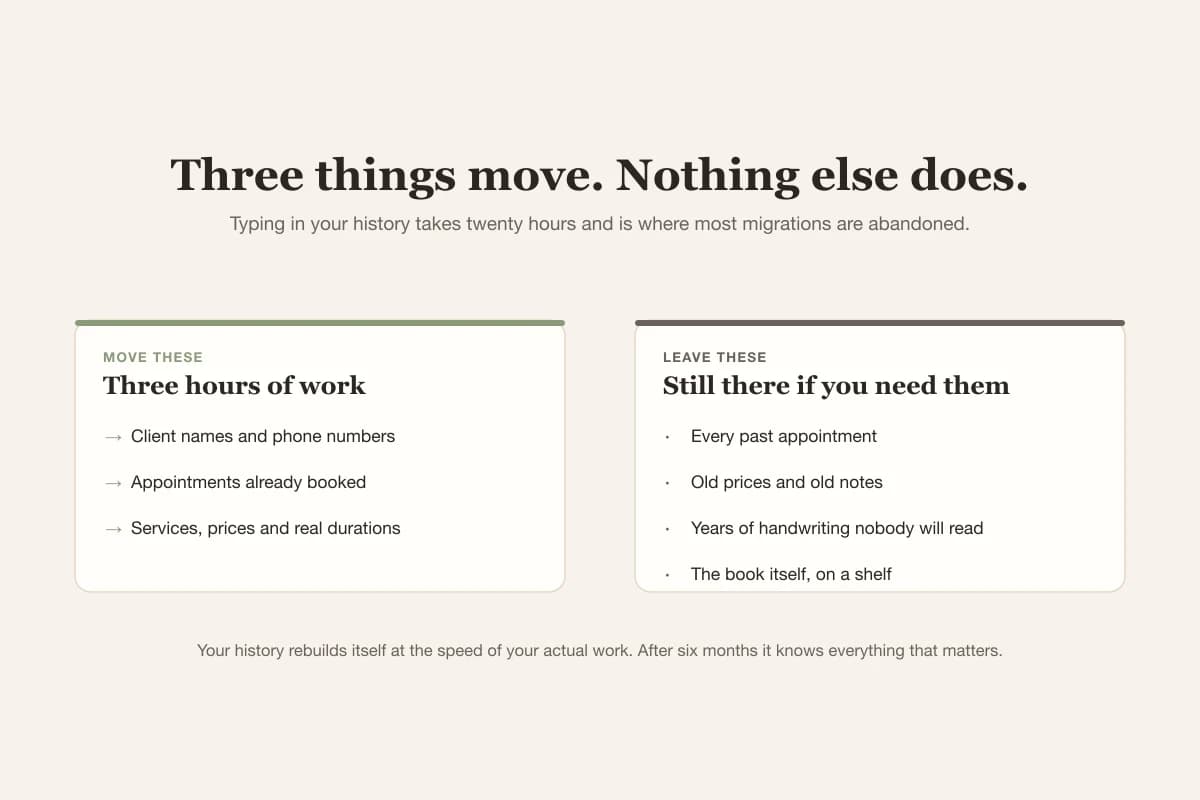
Three things need to move and nothing else does.
- Client names and phone numbers, which you need to send reminders and to recognise a returning client.
- Appointments already booked, from today until the last one in the book.
- Your services, prices and real durations, which is the part worth doing carefully.
Past appointments do not move. The book still exists, sitting on a shelf, and you can look something up on the rare occasion you need to.
Your history rebuilds itself at the speed of your actual work, and after six months the new system knows everything that matters.
The seven days
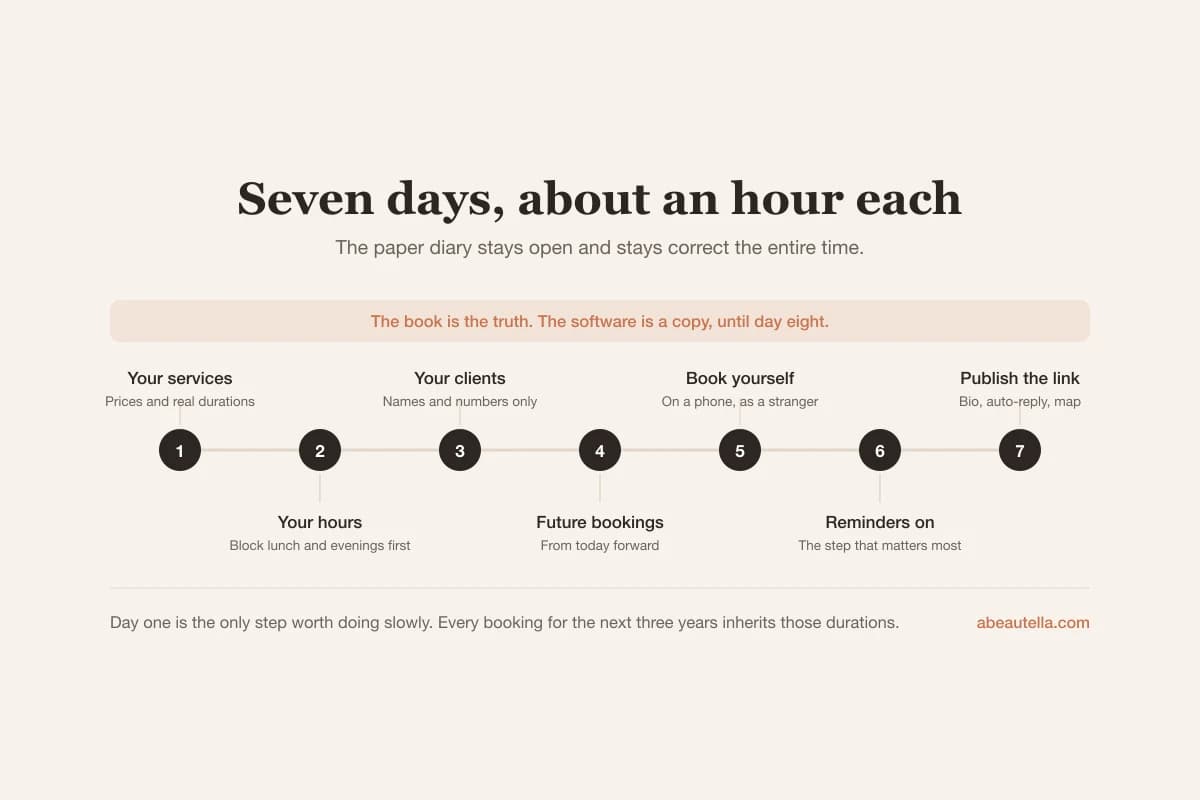
Day one: your services
Enter every service with its price and, more importantly, the time it genuinely occupies you.
Not the time you are working, the time the chair is unavailable, including setting up and clearing down.
This is the only step worth doing slowly, because every booking for the next three years inherits these numbers.
Day two: your hours
Set when you actually work, and block what you want protected: lunch, the school run, the evening you keep.
Do this before anybody can book, not afterwards. A system that says yes at eight on a Sunday will keep saying yes.
Day three: your clients
Names and phone numbers only, from your phone contacts if that is where they live, which for most salons it is. What belongs in a fuller client record can wait.
An hour of typing at most. Anybody missing gets added the next time she books, which costs nothing.
Day four: future appointments
Everything in the book from today forward. For most salons this is three or four weeks and about ninety minutes.
Check the total against the book when you finish. This is the one place an error would actually hurt.
Day five: book yourself
From your own phone, in a private window, as a stranger. Book, read the confirmation, then cancel and read that too.
Fix whatever felt awkward. This is the last cheap moment to change anything.
Day six: turn on reminders
Twenty-four hours ahead. Read the wording and change it into something you would actually send.
This single step does more for a salon than everything else in the week combined, as the evidence in nine methods against no-shows sets out.
Day seven: publish the link
In your bio, in your automatic reply, on your map profile. Where each of those goes is covered in your booking link.
Then wait, because the first online booking usually arrives the same evening and it is a strange and good feeling.
What the first two weeks feel like
Worth knowing in advance, because the difficult part is not the setup and nobody warns you about the part that is.
| What happens | What to do | |
|---|---|---|
| Days 1 to 3 | You keep reaching for the book first | Let yourself. The book is still correct |
| Days 4 to 7 | The first online booking arrives | Check it against the diary, then relax slightly |
| Week 2 | You notice the day running late | Your durations are short. Add ten minutes |
| Week 3 | Somebody books your lunch | You did not block it. Block it now |
| Week 4 | You stop opening the book | Nothing. This is the whole point |
The duration problem in week two is the most common and the most fixable, and it is not a failure of the software.
A paper diary is forgiving. You write a name in a slot and quietly absorb the overrun, and nobody ever measures it.
Software holds you to what you entered, which is uncomfortable for a fortnight and then makes the whole day calmer.
Add ten minutes to your three most common services after two weeks. Almost every salon needs to and almost none expect to.
Telling clients
Less of a moment than it feels like. Most people will simply use whatever is in front of them.
There is no need for an announcement, and an announcement invites questions from people who had none.
Mention it at the chair, once, to the clients who are in that week, and let the rest discover it.
The important half is the last four words. Nothing about her experience is changing except that booking got easier.
And keep taking bookings the old way for anyone who prefers it. Nobody has to be moved for the system to be worth having.
What usually goes wrong
Four things, and three of them come from being too ambitious in the first fortnight.
Service durations that are too optimistic. Everybody enters the time the work takes rather than the time the chair is gone, and the day then runs late from ten.
Hours that were never blocked. Somebody books your lunch, and once is enough to make you distrust the whole thing.
Typing in history. Covered above, and the single most common reason a migration is abandoned.
Closing the paper diary on day three. The plan works because both run for a week. Cutting that short is how a Saturday goes wrong.
The first is worth checking after two weeks rather than assuming. Real durations are almost always longer than the entered ones.
If you have staff
Everything above works for a salon of one. With a team there are three additions, and one of them decides whether it survives.
Do it in your quietest week, not before a busy season. A team learning a new system in December is a bad plan.
Give one person the paper diary. Somebody has to own the copy that is still the truth, or both versions drift.
Decide who can change what before anybody logs in, rather than discovering it after somebody moves an appointment they should not have.
The one that decides whether it survives is simpler than any of those and it is about people rather than settings.
If one person keeps taking bookings on paper only, the software is wrong within a day and everybody stops trusting it.
That is not a technology problem and no feature fixes it. It needs saying out loud, once, before the week starts.
One rule, agreed in advance: for these seven days, everything goes in both places, and nobody is exempt.
When to keep the diary
There are real cases where none of this is worth doing, and an honest article should say so.
If you are fully booked from a client list that has not changed in five years, online booking is solving a problem you do not have.
If somebody is always at the desk to answer the phone, the largest gain here mostly disappears.
And if you genuinely never have a missed appointment, the second largest gain disappears too.
In that situation, keep the book. Nothing above is worth an hour a day for a week to fix something that is not broken.
The salons that gain most are the ones losing evening enquiries and absorbing two missed appointments a week without counting them.
What day eight looks like
You check the software against the book one last time, and if they match, the book goes on the shelf.
Do not throw it away. It is your only copy of everything before this week, and it costs nothing to keep.
Expect to reach for it twice in the first month out of habit, and then to stop noticing that you have not.
The change most people report is not about the calendar at all. It is that the evening stops being a shift spent answering messages.
Which was the actual problem, even though it was never the reason anybody gave for wanting to move.
The reason given is usually organisation. The relief, six weeks later, is almost always about the hours between closing and sleeping.