A no-show is not the same as a cancellation. A cancellation gives you the hour back. A no-show takes it and pays nothing.
It is also rarely deliberate. Almost nobody books an appointment intending to skip it, and almost everybody has done it once.
That matters, because it tells you what to fix. You are not dealing with bad clients. You are dealing with forgetting, and with the awkwardness of cancelling late.
Everything below works on one of those two. None of it requires being strict, and none of it needs you to chase anyone.
What an empty chair actually costs
Start with the number, because it decides how much effort this deserves. A missed appointment is not a lost service, it is a lost hour.
You paid rent for that hour. You paid a salary for it, if someone was on shift. Neither of those is refunded because nobody came.
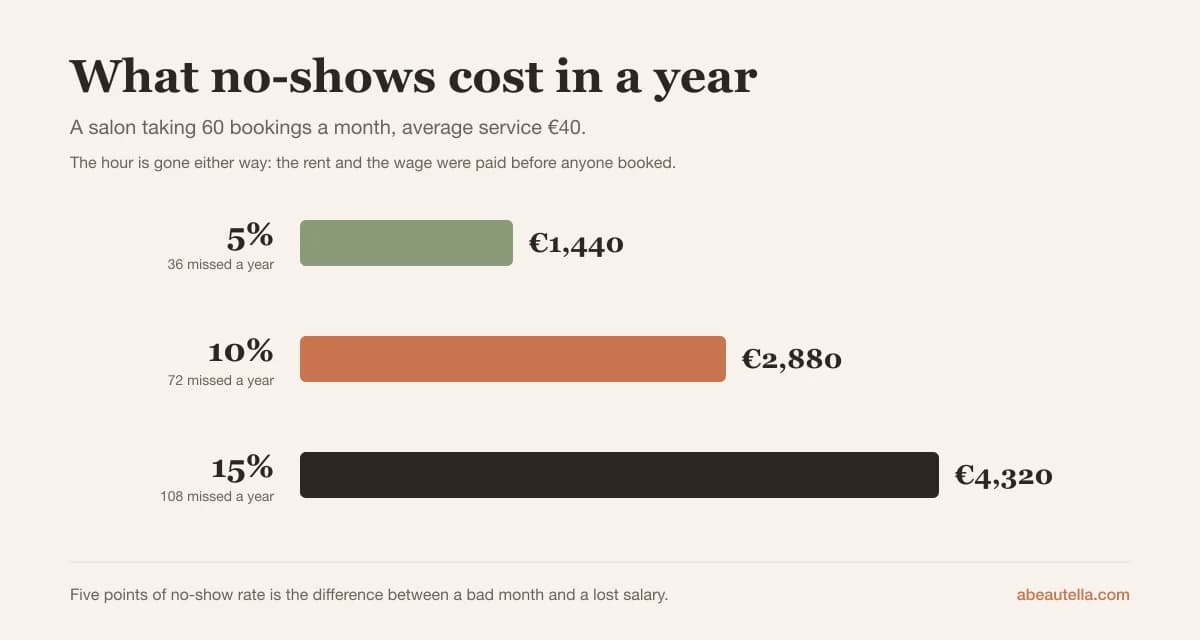
At sixty bookings a month and a €40 average, a one in ten no-show rate costs you €2,880 a year. That is a salary's worth of empty chairs.
Why people do not show up
Four reasons cover almost all of it, and they are worth naming, because each one has a different fix.
- They forgot. The appointment was made three weeks ago, in a message thread they have not opened since.
- Something came in front of it. A child, a shift change, a car. The appointment lost, quietly.
- They wanted to cancel and could not face it. Messaging you at nine in the evening to say they cannot come feels worse than saying nothing.
- It cost them nothing to miss. Not a moral failure, just the absence of any reason not to.
Notice that only the last one is about money. Three quarters of the problem is memory and awkwardness, which are cheaper to fix.
The nine methods, at a glance
| Method | Effort | Works on | Effect |
|---|---|---|---|
| Confirm the moment they book | None, once set up | Forgetting | Small but free |
| Remind 24 hours before | None, once set up | Forgetting | The largest single gain |
| Make cancelling one tap | None, once set up | Awkwardness | Turns no-shows into cancellations |
| Deposit on long services only | A decision, once | Cost of missing | Strong, on the bookings that hurt most |
| Hold a card without charging | A decision, once | Cost of missing | Strong, and softer than a deposit |
| Offer the freed hour immediately | None, once set up | Recovering the loss | Turns a loss into a booking |
| Book closer to the date | A habit change | Forgetting | Quiet and underrated |
| Track who repeats it | Two minutes a month | Knowing where you stand | Enables the last one |
| Change terms for repeaters only | A conversation | Cost of missing | Fixes the tail without punishing everyone |
Make the appointment hard to forget
1. Confirm at the moment of booking
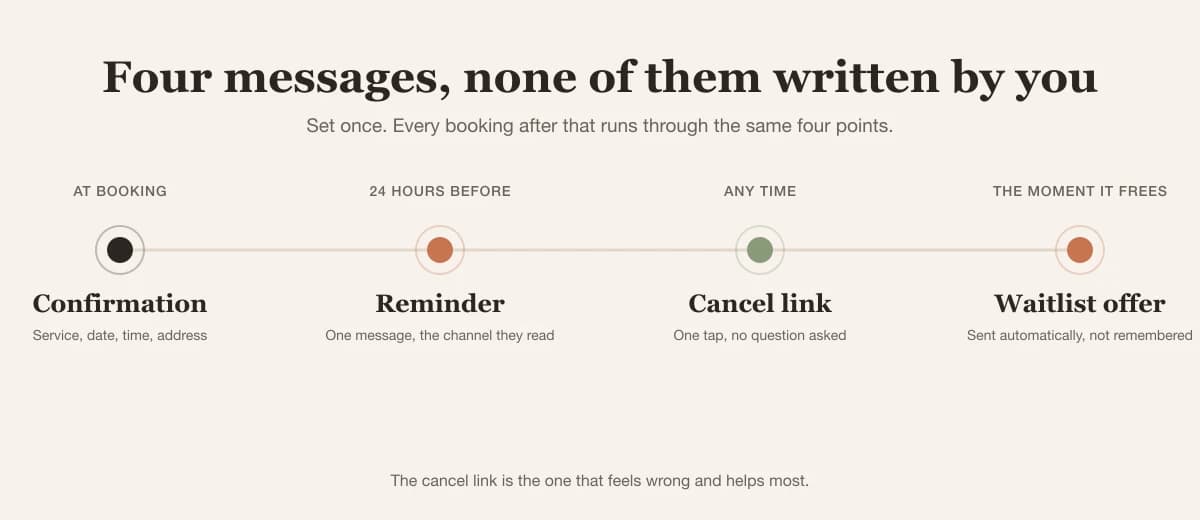
A confirmation arriving within seconds does two things. It proves the booking exists, and it puts the date somewhere they can find it.
Include the service, the date, the time and the address. A confirmation that says only “see you soon” is decoration.
2. Remind twenty four hours before
This is the single most effective thing on the list, and it is entirely automatic. One message, the day before, on the channel they actually read.
Twenty four hours is the right distance. Earlier and they forget again. Later and they cannot rearrange their day even if they wanted to.
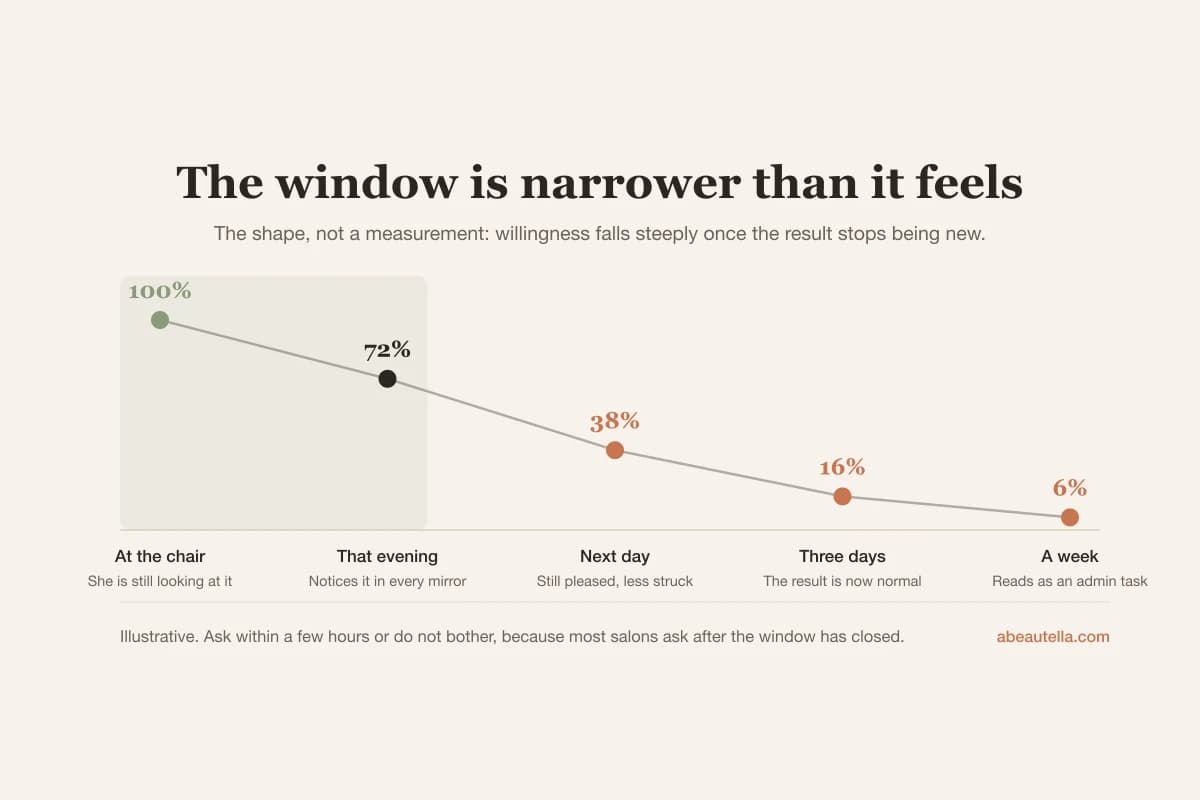
The wording matters more than most people expect. In two randomised trials on hospital appointments, changing only the text of the reminder cut missed appointments by about a quarter.
What worked was naming what the miss costs. Not a threat and not a fee, just the plain figure, stated once.
3. Book closer to the date
The further ahead a booking is made, the more likely it is to be missed. Life has more chances to get in the way.
You cannot refuse a booking six weeks out, but you can open more near-term slots, and remind those long bookings twice.
This matters most for a colour salon, where appointments are made furthest ahead and forgotten most often.
Make cancelling easier than disappearing
4. Put a cancel link in every message
This feels wrong the first time you read it. Why make it easier for someone to cancel on you?
Because they were going to miss it either way. A cancellation at eight in the evening gives you the morning to fill the slot. Silence gives you nothing.
Salons that add a one-tap cancel link usually see cancellations rise and no-shows fall by more. That is a straight win.
5. Never make them explain
A cancellation form asking for a reason is a wall. Most people will close it and simply not turn up.
One tap, no question, immediate confirmation. You can ask why later, warmly, if you want to know.
Give the appointment weight
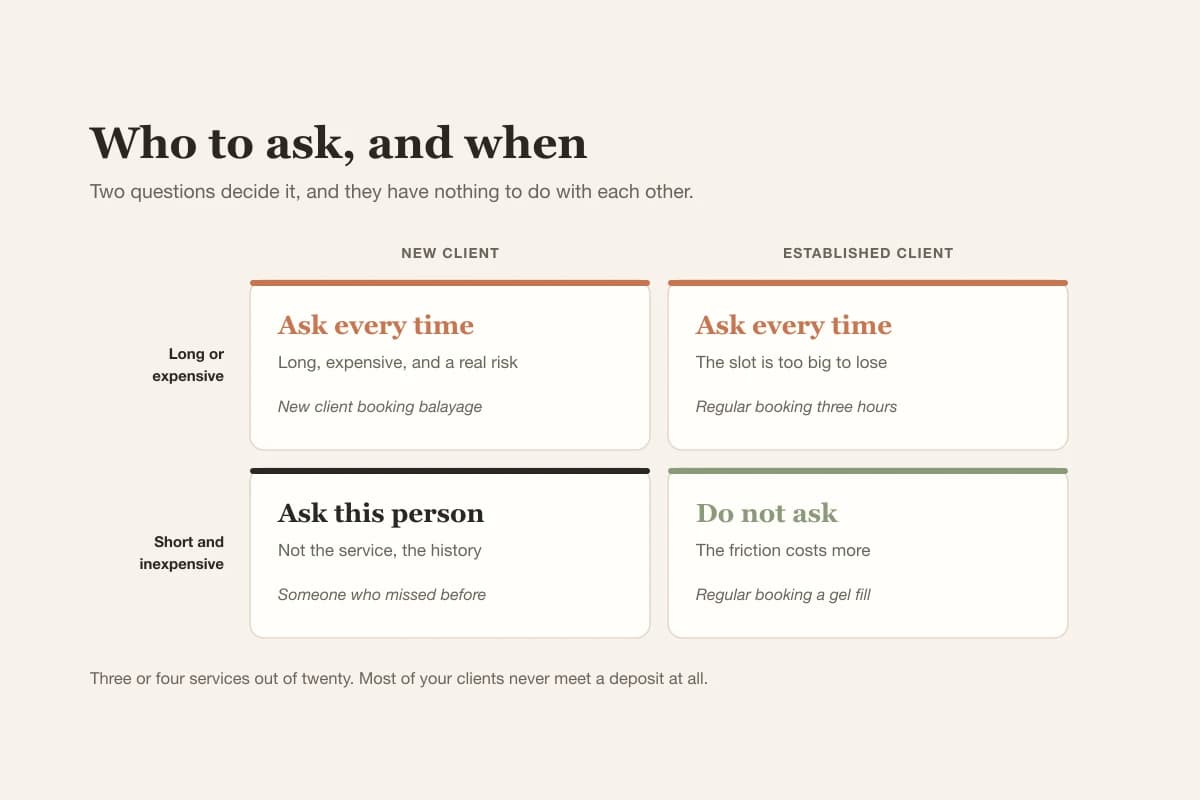
Now the money part, and it is worth being careful here. A deposit reduces no-shows and it also loses you bookings.
6. Ask a deposit only on the long services
A missed thirty minute manicure costs you thirty minutes. A missed three hour colour costs the whole afternoon.
Charge a deposit where the loss is large and skip it where it is small. A nail salon may need none at all; a massage studio probably does.
Twenty to thirty per cent is usually enough. The point is that the booking now costs something to abandon, not that you recover the loss.
7. Hold a card instead of taking money
Saving a card and charging only for a missed appointment is softer than a deposit, and it works nearly as well.
Nothing leaves the client's account when they book. Say the terms plainly at booking, and charge only when you genuinely lost the hour.
Fill the hour you lost
8. Offer the slot the moment it frees
Half the value of reducing no-shows is not preventing them. It is filling the gap when one happens anyway.
Keep a waitlist of clients who said they would take an earlier time. When a slot opens, they hear about it in seconds, not when you remember.
A cancellation at eight in the evening, offered automatically overnight, is often booked by breakfast. The same cancellation handled by hand is usually a lost morning.
9. Track repeats, then change terms for them alone
Most no-shows come from a small number of people. You do not need to be strict with everyone to fix that.
Mark it in the client's record when it happens. On the third time, ask that person for a deposit, and keep everyone else on the easy terms.
This is the whole argument for a client record that remembers. Without one, you either punish everybody or you punish nobody.
What to say, and what not to
The words in an automatic message do more work than most people expect, and they cost nothing to change.
A reminder that says only the time is a diary entry. A reminder that gives the client one easy action is a decision point.
| Instead of | Send |
|---|---|
| Reminder: Tuesday 14:00 | Tuesday at 14:00 for your colour. If you cannot make it, cancel here so someone else can take the time. |
| Please confirm your appointment | See you Tuesday at 14:00. Change or cancel any time here. |
| You missed your appointment today | Sorry we missed you on Tuesday. Would you like to rebook? |
| A deposit is required | Long appointments need a 25% deposit, taken now and deducted from the total. |
The third row matters more than it looks. A message after a miss decides whether that person books again or quietly finds somewhere else.
Say it warmly, once, and offer the next slot. Salons that do this recover a surprising share of the people who missed.
Three things that do not work
- Overbooking. It hides the symptom and creates a worse one: two clients in the chair at once, and neither of them happy.
- A deposit on everything. It cuts no-shows and cuts bookings by more. New clients are the first to disappear.
- Messages that make people feel guilty. “We were waiting for you” gets an apology and loses a client. Say nothing, or say it warmly.
How to start this week
- Count last month's misses. Without the number you cannot tell whether anything you do helps.
- Turn on a confirmation and a reminder. These two need setting up once and cost nothing per booking.
- Put a cancel link in both messages. Expect cancellations to rise. That is the mechanism working, not failing.
- Pick your long services and set a deposit on those alone. Announce it at booking, in one sentence.
- Start a waitlist, even a short one, so a freed hour has somewhere to go.
- Count again after a month. Compare with the first number, not with how it feels.
What to expect
Confirmation and reminders alone usually take the biggest single bite out of the rate, and they are the cheapest thing here to switch on.
Deposits on long services close most of what is left. The waitlist does not reduce no-shows at all; it recovers the money from the ones you still get.
None of it reaches zero, and chasing zero costs you more in lost bookings than the last few misses were worth.
Aim for a rate you can live with, measure it every month, and spend the attention you save on the clients who did turn up.
One more thing, and it is the one people forget. Tell your clients none of this.
A reminder that arrives on its own reads as care. The same reminder announced as a policy reads as suspicion, and it changes how the room feels.