Ask a salon how a price was set and the honest answer is usually that it looked about right.
It matched the salon down the road, or it was the old price plus a bit, or it was what the last owner charged.
None of that is stupid. It is what you do when the alternative looks like accounting and you have clients waiting.
But it means your price list was built from somebody else's costs, and it is almost certainly arranged in the wrong order.
The problem with pricing per service
A price list looks like a list of things. It is actually a list of ways to spend an hour.
You do not sell colour or manicures. You sell time, and every line on that list is a different rate for it.
Once you see it that way, the ordering by price stops making sense, because price and duration are not related.
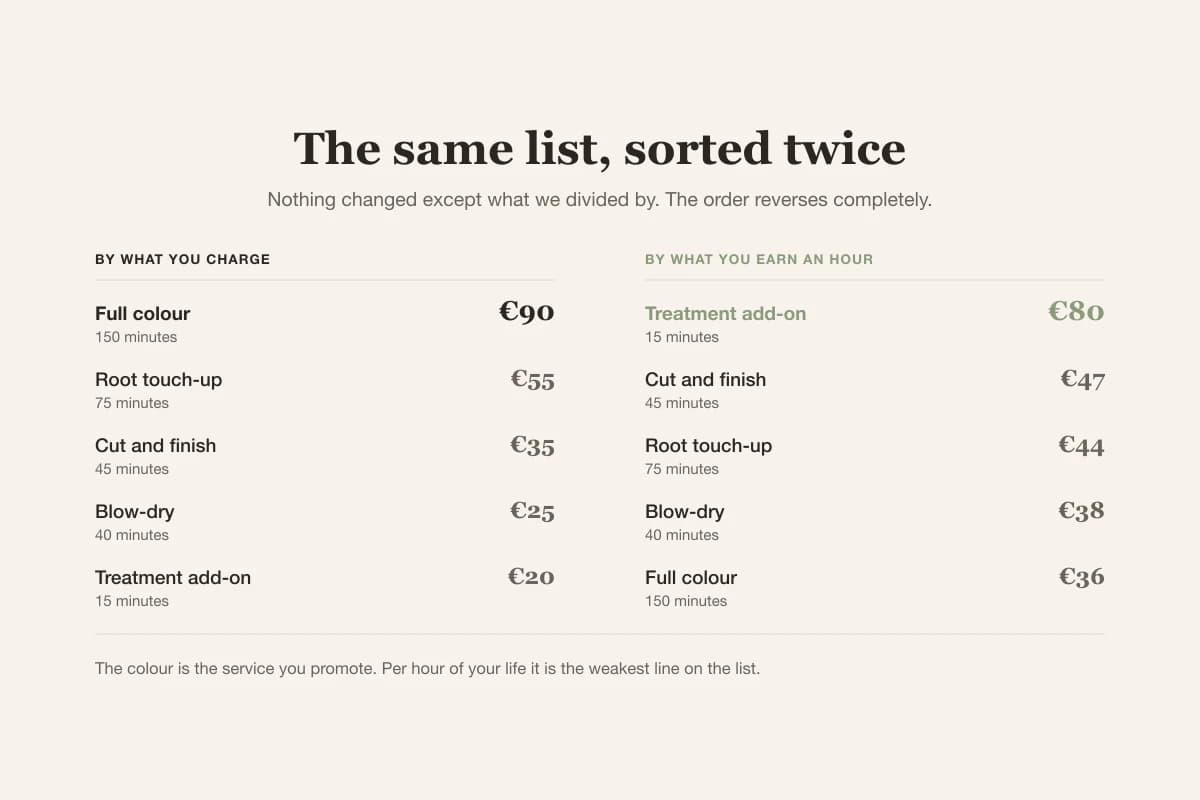
A €90 colour taking two and a half hours earns €36 an hour. A €20 treatment taking fifteen minutes earns €80.
The colour feels like the important service. It is the one you promote, train for, and photograph.
Per hour of your life it is the weakest thing on the list, and almost nobody in the trade knows this about their own prices.
The same list, sorted twice
The real time is the part people get wrong, and it has to include everything the appointment consumes.
Not the time you are actively working. The time the chair, the station and you are unavailable to anybody else.
Consultation, setting up, clearing down, and the five minutes of conversation at the door all belong in it.
For a hair salon, processing time is the exception, because the chair genuinely can be sold during it.
That is the one case where a long service earns better than it looks, and it is set out in software for hair salons.
Building a price from the bottom
There are only three inputs, and two of them you already worked out if you have read about what an empty hour costs.
What an hour costs you
Fixed costs divided by open hours. Rent, utilities, insurance, software, and any wage paid regardless of bookings.
For a four-chair salon this is often around €5 an hour per chair, which is smaller than people expect.
What the service consumes
Product, and only product. Colour, gel, tips, wax, disposables, laundry.
Weigh it once for your three biggest services rather than estimating. Estimates in this trade are consistently too low.
What your time is worth
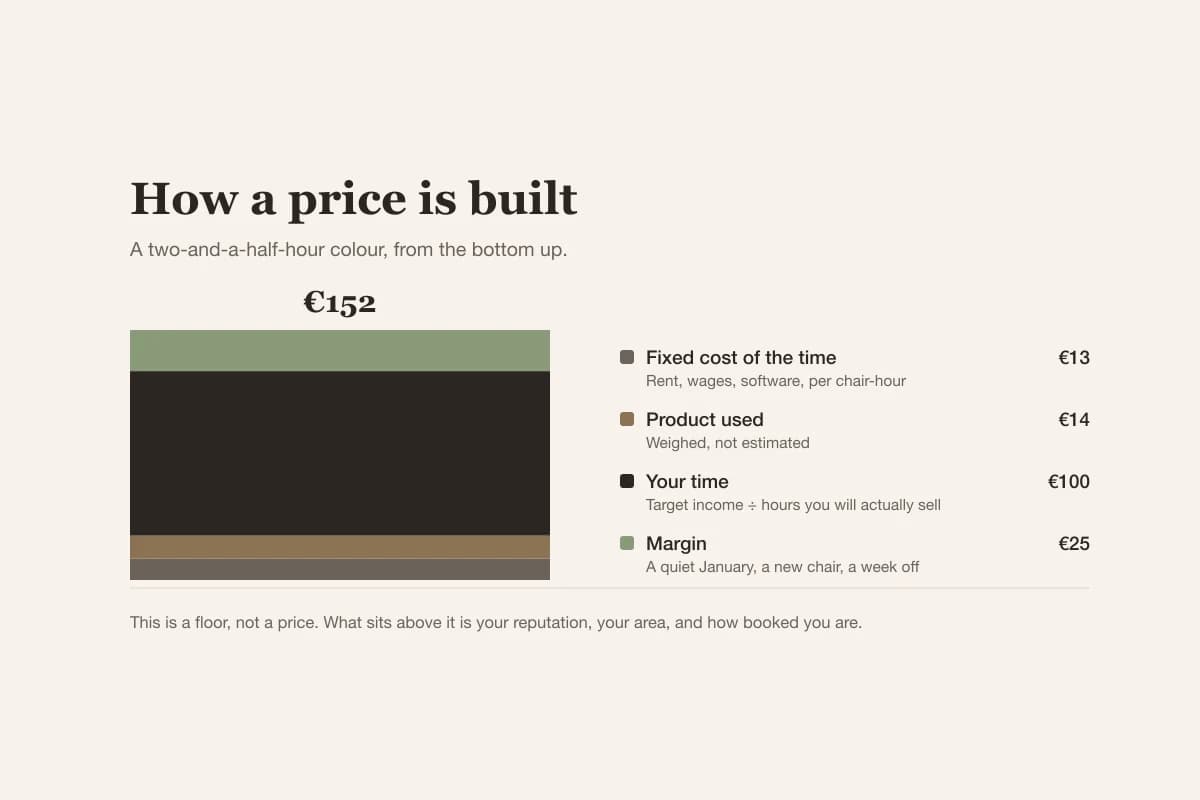
Decide the annual income you want, divide by the hours you will actually sell, and you have an hourly rate to build on.
The second number is where this goes wrong. Nobody sells every open hour, and pricing as though you will guarantees a shortfall.
Eighty per cent occupancy is a realistic figure for a healthy salon, and your own numbers will tell you where you sit.
Margin
What is left over is what pays for a quiet January, a new chair, a course, or a week off.
A price that covers costs and your wage exactly is a price that cannot absorb anything going wrong.
A worked example
| Layer | A 45-minute cut | A 2.5-hour colour |
|---|---|---|
| Fixed cost of the time | €3.90 | €13.00 |
| Product used | €1.50 | €14.00 |
| Your time at €40 an hour | €30.00 | €100.00 |
| Subtotal | €35.40 | €127.00 |
| Plus 20% margin | €42.50 | €152.40 |
Two things usually happen when a salon runs this for the first time.
The short services turn out to be underpriced, sometimes badly, because their fixed overhead was never counted.
And the long services turn out to be priced roughly right, which is reassuring and also why nobody noticed the problem.
The calculation is not an instruction to charge €152 for a colour. It is a floor, and knowing the floor changes what you do above it.
Above the floor sits everything the calculation cannot see: your reputation, your area, how far people travel, and how booked you are.
A salon booked three weeks ahead is telling you its prices are below what the market will pay, and no spreadsheet will say that.
What to do with the answer
Finding that half your list is underpriced does not mean raising half your list. There are gentler moves that work better.
- Fix the short services first. They are the most underpriced and the least likely to be compared against another salon.
- Promote the high-earning ones. A treatment earning €80 an hour deserves the attention your colour work currently gets.
- Shorten rather than raise. Ten minutes removed from a service is a price rise nobody notices or objects to.
- Stop discounting what already earns least. A promotion on your weakest hourly rate is an expensive way to be busy.
- Reprice the add-ons. These are almost always the highest-earning minutes in the salon and the last to be reviewed.
The third one deserves emphasis because it is invisible to clients and immediate in effect.
Most services in this trade have accumulated time rather than been designed. Reviewing them recovers hours nobody was paid for.
Raising prices, in practice
This is the part people dread, and most of the dread is about the announcement rather than the money.
How much
Enough to matter and not enough to require a conversation. In practice that is somewhere between five and ten per cent.
Smaller than that is not worth the anxiety. Larger than that needs explaining, and explaining invites negotiation.
When
Once a year, on a date you choose and keep. A predictable rise is far easier to accept than an unpredictable one.
Avoid doing it in your busiest month, when a client rebooking feels the change immediately and has no time to absorb it.
How to say it
In advance, in writing, without a justification. Prices rise; every business your clients use does the same thing.
Naming the reason invites debate about the reason. Naming the date does not.
That last sentence is what makes it land well. It costs you very little and it removes the feeling of being caught out.
What actually happens afterwards
The fear is that clients leave. What happens is usually smaller and stranger than that.
A very small number say something, usually one or two, and almost all of them stay anyway.
A slightly larger number quietly stretch their interval, coming every seven weeks rather than six, which is a real cost worth watching.
And most people do not react at all, because they do not know your old prices as precisely as you think.
Watch the interval rather than the complaints. Complaints are loud and rare; interval drift is silent and adds up.
If bookings hold and intervals hold for three months, the rise worked and you waited too long to make it.
What clients actually notice
Pricing decisions get made against an imagined client who studies your list and compares it line by line. She does not exist.
What a real client notices is narrower, and knowing which three things they are makes the whole exercise less frightening.
The total, not the line
She remembers what she paid on the way out, which was probably a service plus something added at the chair.
That means the add-on you have not repriced since 2022 is part of the number she recalls, and repricing it is barely visible.
The interval, not the price
Nobody budgets for a colour. They budget for a colour every seven weeks, which is a monthly figure in their head.
So a rise of a few euro is absorbed, but a rise that pushes the monthly figure past a round number is felt.
That is why intervals stretch after a price rise rather than clients leaving. The budget held; the frequency gave way.
The first price she ever paid
Whatever she paid on her first visit becomes her reference point, and it stays her reference point for years.
Which means a discounted first visit is expensive twice: once when you give it, and again every time you raise prices afterwards.
New clients are better won with something that is not a lower price, for exactly this reason.
The mistakes worth avoiding
Four recur often enough to name, and all four come from pricing per service instead of per hour.
Matching the salon down the road. Their rent, their staff and their product costs are not yours, and you cannot see any of them.
One price for work that varies. Colour correction and nail art take whatever they take. A range with a consultation is honest; a fixed price is a loss.
Never repricing the add-ons. These are the highest-earning minutes you have and they are usually years out of date.
Discounting to fill structurally empty hours. Aim the offer at the hour, not at the service, or you will discount your best work to your best clients.
That last one is the expensive mistake, and the reasoning behind it is in what an empty hour costs.
An afternoon's work
- Write out every service with its real occupied time, including setting up and clearing down.
- Divide price by hours and re-sort the list. Expect the order to reverse.
- Weigh the product for your three biggest services rather than estimating it.
- Work out your fixed cost per chair-hour, if you have not already.
- Build one price from the bottom and compare it to what you charge. Start with your most common service.
- Fix the worst three lines, and leave the rest until next year.
Nobody rebuilds a whole price list in one go, and trying to is how the job never gets started.
Three lines a year, done properly, is a different business inside five years.
One warning about the first pass: the numbers will look worse than the salon feels, and that is normal rather than alarming.
Almost every salon has been absorbing an underpriced line for years without noticing, because the total each month still worked.
Finding it is the useful part. Nothing about your business got worse the day you measured it.