Almost every salon owner knows reviews matter and almost none ask for them consistently.
The reason is always the same and it is worth naming: it feels like asking a favour from somebody who has just paid you.
That feeling comes from a wrong picture of what is happening, and once the picture changes the awkwardness mostly goes.
She is not doing you a favour. She has just had something done that she likes, and she wants to tell someone about it.
The reframe that removes the awkwardness
Think about the twenty minutes after a good appointment, from her side rather than yours.
She is looking in the mirror, taking a photograph, deciding who to show it to. The impulse to say something already exists.
You are not creating that impulse. You are giving it somewhere to go before it fades.
That is a genuinely different request from asking someone to do you a favour, and it sounds different when you say it.
The salons that ask comfortably are the ones who understand this. The rest are apologising for something nobody minds.
Timing does most of the work
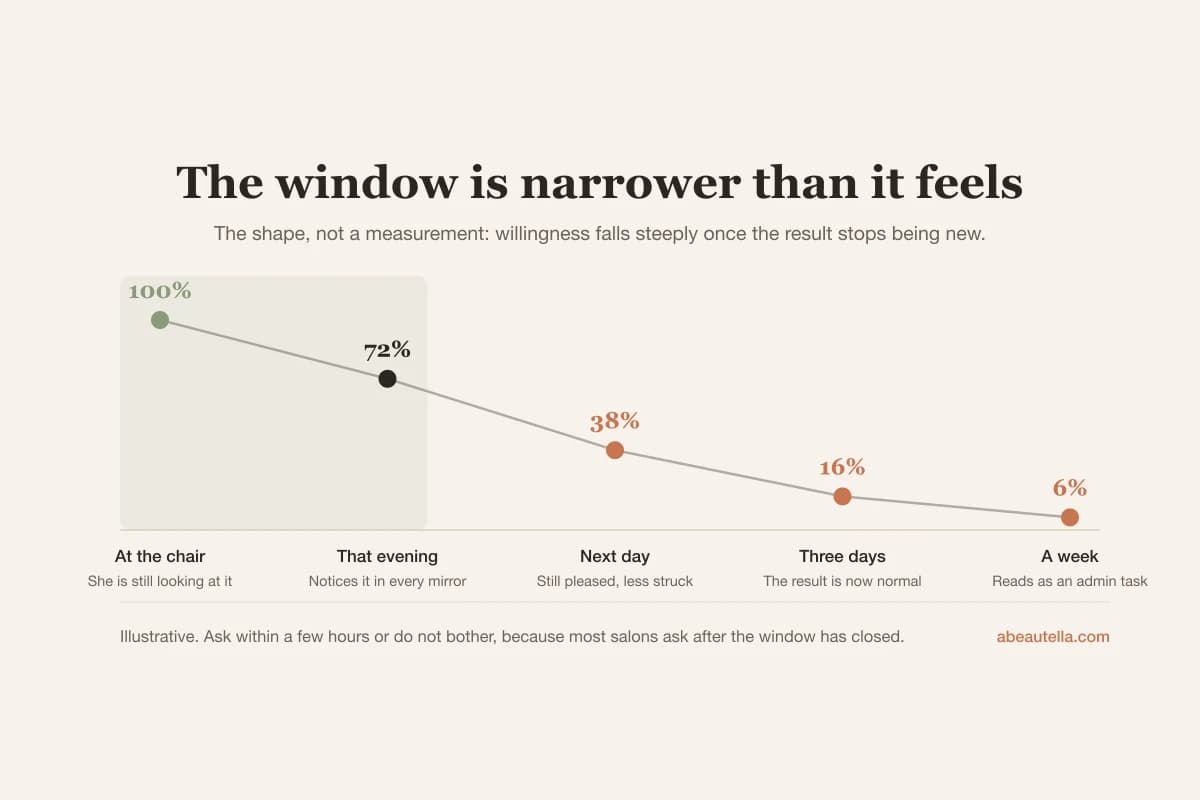
The willingness to write something is highest immediately and falls quickly, which is not how most salons ask.
An email three days later arrives when the appointment is a memory and the result is normal rather than new.
There are only two good moments, and they are close together.
At the chair
While she is still looking at the result and has said something pleased about it. This is the strongest moment there is.
It is also the one that feels most awkward, which is why almost nobody uses it and why it works.
The same evening
A short message a few hours later, while she still notices the result every time she passes a mirror.
This is the practical option, because it can be automatic and it does not require you to say anything out loud.
Where to send them
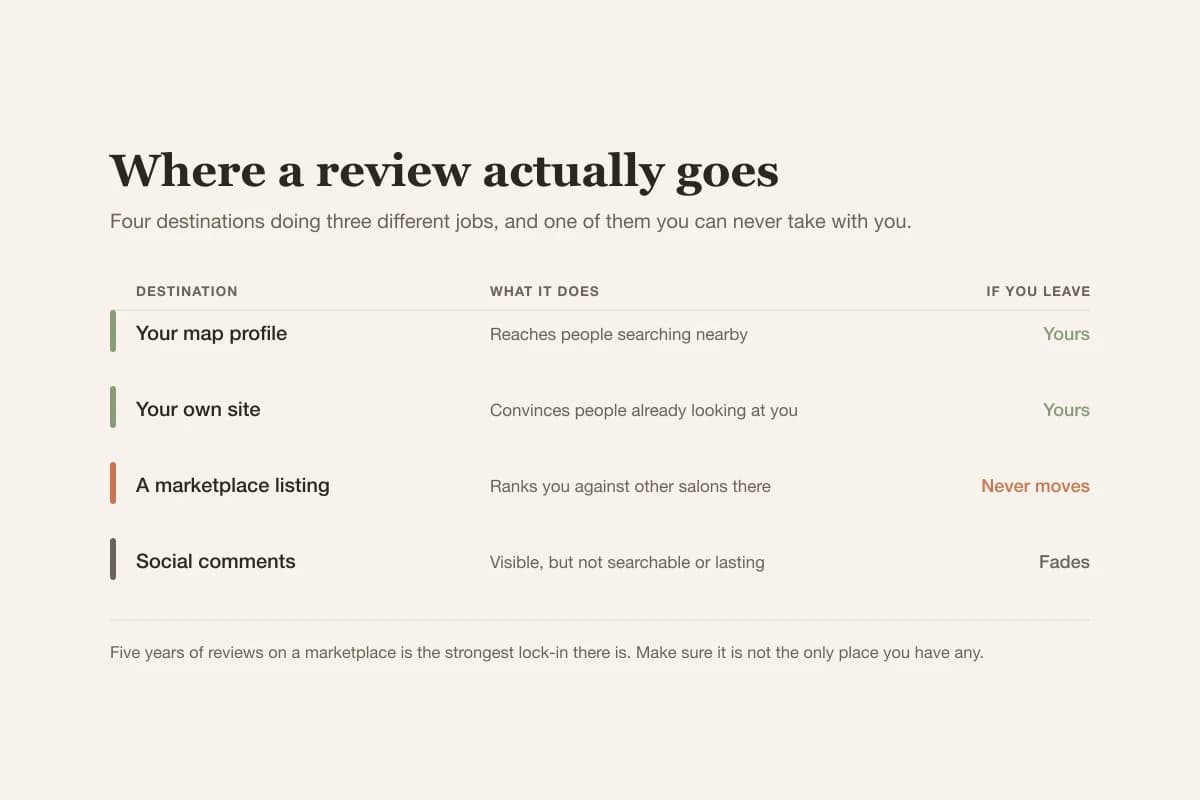
This decision matters more than the wording and almost nobody makes it deliberately.
| Where | What it does | Can you take it with you? |
|---|---|---|
| Your map profile | Brings people searching for a salon nearby | Yes, it is your listing |
| Your own site | Convinces people already looking at you | Yes |
| A marketplace listing | Ranks you against other salons there | No, ever |
| Social comments | Visible, but not searchable or lasting | Not really |
The third row is the one to think about carefully, because it is the easiest place to accumulate reviews and the only place you can never move them from.
Five years of five-star reviews on a marketplace is the strongest form of lock-in there is, as set out in marketplace or your own link.
That is not an argument for refusing them. It is an argument for making sure they are not the only place you have any.
Send most people to your map profile, which is yours, findable, and reaches people who were not looking for you by name, then show a few on your own site.
How to actually ask
Three rules, and the third is the one that changes the response rate most.
Be specific about where. Somewhere to leave a review is a task. A link straight to the box is a tap.
Be specific about what. A blank page is hard. A question is easy, and the answers are more useful to read.
Say why it helps. Not to flatter you, but because it genuinely helps someone else decide, which is a reason people accept.
The specific prompt at the end matters. Asking about one thing produces a better review than asking about everything.
Who to ask, and who not to
Asking everybody is the fastest way to accumulate mediocre reviews and the occasional bad one you could have avoided.
- Anyone who said something pleased during the appointment. This is the whole list, really.
- Regulars, once. They have the most to say and are the least likely to be asked, because it feels unnecessary.
- A new client whose first visit went well, because her review will describe the thing new clients worry about.
- Not anyone who seemed quiet or unsure. Ask her how it went instead. That is a different and more useful conversation.
- Not anyone you have already asked. Once is a request; twice is pressure.
The fourth is where most damage gets done. A hesitant client asked for a public review will sometimes give you one.
Ask her privately what she would change instead. You will learn something and you will often fix the problem.
That conversation is more valuable than the review would have been, and it happens before anything is public.
What to do about a bad one
It will happen, and how it is handled matters more than the review itself, because everyone reads the reply.
A bad review with a calm, specific answer underneath it does less damage than a page of uniform praise does good.
Readers are looking for how a business behaves when something goes wrong, and a bad review is the only place they can see it.
- Wait a day. Nothing written in the first hour is your best version of it.
- Reply publicly, briefly, once. Thank her, acknowledge the specific thing, say what you would do.
- Move it private. Offer a way to continue that is not a comment thread.
- Do not argue about facts, even when you are right. Nobody reading is scoring the argument.
- Then keep asking happy clients, because volume and recency are what actually dilute one bad month.
The last step is the real remedy. A salon asking consistently has a bad review sitting eleventh rather than second.
Volume matters less than recency
Two salons with the same number of reviews are not equal if one stopped collecting them two years ago.
A recent review says the salon is still good. An old one says it was good once, which is a much weaker claim.
That is why a steady trickle beats an occasional push, and why asking twice a week forever beats asking forty people in March.
Two a week is about a hundred a year, which is more than most salons in any town.
And two a week is achievable without a campaign, because roughly two clients a week say something pleased anyway.
The whole job is noticing when that happens and having a link ready to send, in the same way a booking link should always be within reach.
What makes a review persuasive
Not every five-star review is worth the same, and the difference is easy to influence with a single word in the request.
A reader is not counting stars. She is looking for someone whose situation resembled hers, to find out what happened.
So the useful reviews are the specific ones, and the useless ones are the warm generalities.
| A review that says | Does | Because |
|---|---|---|
| Lovely salon, highly recommend | Very little | It describes a feeling, not an experience |
| She fixed a colour another salon got wrong | A great deal | It answers a specific fear |
| First time getting lashes and she explained everything | A great deal | It speaks to the nervous first-timer |
| Always on time and never rushed | More than it looks | These are the two commonest worries |
Which is why the request should name a topic rather than leaving a blank page.
Ask about the consultation, or about how the colour has lasted, or about the first visit if it was one.
You will get shorter reviews and better ones, and each will do work that a general compliment cannot.
Think about what a hesitant stranger is actually worried about, and prompt for exactly that.
What not to do
Three things reliably backfire, and one of them is common enough to be worth stating plainly.
Do not offer anything in exchange. It is against the rules of every review platform, it is visible in the pattern, and the reviews read as bought.
Do not ask only the people you expect to be positive, in a way that filters. Asking pleased clients is fine; screening for a rating first is not.
Do not write them yourself, or ask family to. It is obvious, it is detectable, and one removal takes the rest with it.
The temptation is strongest at the start, when the page is empty and five reviews would change everything.
Five real ones take a fortnight of asking. That is a much shorter wait than it feels like on the first day.
And an empty page with a handful of genuine reviews reads better than a full one where every entry sounds the same.
A fortnight to a real page
- Claim your map profile if you have not, and get the direct review link from it.
- Put that link where you can reach it in one tap, because you will use it when your hands are busy.
- Add it to your receipt or the message that goes out after an appointment.
- Ask out loud once a day, only when somebody has already said something pleased.
- Reply to every review, good and bad, in one line. This is visible and almost nobody does it.
The fourth step is the whole habit and it takes a week to stop feeling strange.
After that it is simply part of the conversation you were already having at the mirror.
One thing to watch in the first fortnight: you will ask three people, get one review, and conclude it does not work.
A third is roughly the rate, and it is a good one. Nobody leaves a review for every business they are happy with.
Judge it at fifty asks rather than at five, by which point the page will look different enough to notice.