

A salon of one has a simple calendar. You are either free or you are not, and there is nothing else to check.
At two people it stops being simple, and at three it becomes the thing that goes wrong most often.
The usual explanation is that somebody was careless. Almost always the real cause is structural and it is worth understanding.
An appointment does not consume one thing. It consumes three, and most calendars only keep track of the first.
The three things a booking uses
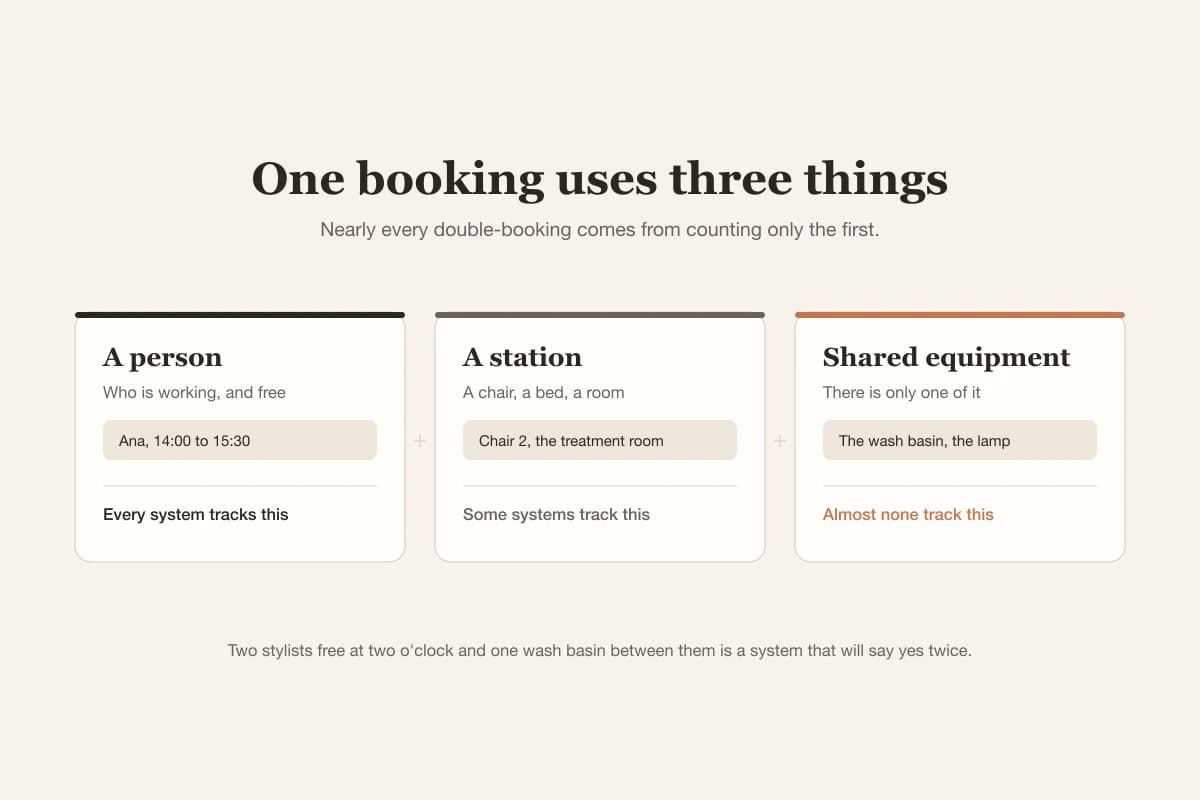
Separating them is most of the solution, because once they are separate the conflicts become visible in advance.
A person
The one everybody tracks. Who is working, when, and whether she is already with somebody.
This is where every booking system starts and, in many of them, where it stops.
A station
A chair, a bed, a room. There are a fixed number and they cannot be shared, no matter how many people are free.
Three stylists and two chairs is a salon that will double-book, and no amount of care prevents it.
Shared equipment
One wash basin. One lamp. One steamer. One machine that only one treatment uses.
These cause the most frustrating conflicts because they are needed for ten minutes and block the whole booking.
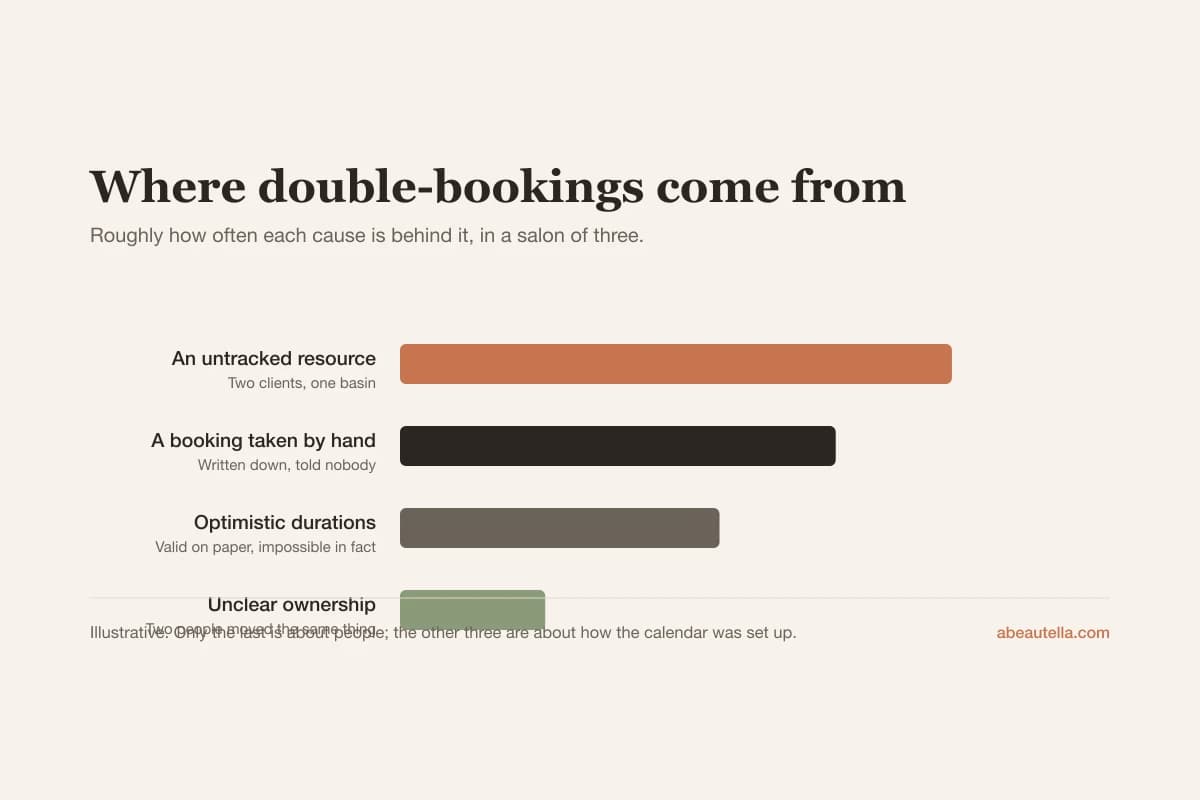
Where double-bookings actually come from
| Cause | What it looks like | The fix |
|---|---|---|
| An untracked resource | Two clients, one basin, same ten minutes | Model the resource, not just the person |
| A booking taken by hand | Somebody wrote it down and told nobody | One place for everything, no exceptions |
| Optimistic durations | Not a clash on paper, a clash in reality | Add ten minutes to the three biggest services |
| Unclear ownership | Two people moved the same appointment | Decide who can change what |
The third is the one nobody counts as a double-booking, and it causes as much damage as the others combined.
A day that is technically valid and practically impossible produces the same result: two clients waiting and one of them unhappy.
Overruns compound. One appointment ten minutes long at ten in the morning is forty minutes late by four in the afternoon.
With a team it compounds sideways as well as forwards, because a stylist running late holds the basin somebody else was waiting for.
One optimistic duration in one column can therefore delay a whole salon, which is not obvious until it happens.
Buffers, and where to put them
The instinct is to add a gap after every appointment. That is expensive and it is not where the problem is.
Most overruns come from a small number of services, and they are usually the ones involving a consultation or a variable result.
So put the buffer inside those services rather than between all of them.
A colour correction entered at three hours when it takes three hours and twenty is a buffer that protects the whole day.
A five-minute gap after every fifteen-minute service is four lost appointments a day and protects nothing.
The way to find out which services need it is to record what they actually take, which is one field on a client record.
Who owns the calendar
This decides more about whether a salon runs smoothly than any setting, and most salons never decide it explicitly.
Three arrangements exist and all three work. What does not work is having none of them and assuming everybody understands.
- One person owns everything. Simple, safe, and it becomes a bottleneck the day she is ill.
- Everyone owns their own column. Works well for rented chairs, and needs a rule about who owns the shared resources.
- Everyone can see everything, one person can change it. The usual answer for a salon of three to six, and the one worth defaulting to.
Whichever you pick, say it out loud once. The failure mode is always the same: two people helpfully fixing the same problem in opposite directions.
And decide what happens to a booking somebody cannot take. Reassigned, or cancelled, is a rule rather than a judgement call at eight in the morning.
Letting clients choose a person
Almost every salon offers this and almost none think about what it does to the calendar.
A client who always books Ana is loyal to Ana, which is good for retention and hard on the rota.
Two effects follow, and the second is the one that hurts.
Ana fills up first, so the salon looks fully booked when a third of the chairs are empty.
New clients see no availability, because the only free slots belong to somebody they have not heard of.
The fix is not to remove the choice, which would cost you more than it saves.
Offer any available specialist as the first and default option, with named people underneath it as a deliberate choice.
Most new clients take the default, which is exactly the outcome you want, and regulars still choose the person they came for. For a barbershop this matters most of all.
The rota itself
Two questions, and getting them the wrong way round is what makes rotas take an afternoon every week.
When is the salon open? Fixed, decided once, and it should change perhaps twice a year.
Who is in on which day? Variable, and this is the only part that needs weekly attention.
A system that requires you to restate the opening hours every time somebody swaps a shift is costing you an hour a week for nothing.
Set a repeating pattern per person, then edit the exceptions. Most weeks have one or two exceptions rather than a fresh rota.
And put holidays in as far ahead as you know them, because a booking taken for a week somebody is away is the hardest one to unwind.
That one is worth a rule rather than good intentions: nothing is agreed until it is in the calendar, including your own time off.
A week mentioned in passing in March is a week that gets booked over in April, every time, in every salon.
The same applies to training days and to the afternoon somebody leaves early, which are the two most commonly forgotten.
When somebody is off
A stylist is ill on Tuesday and has nine appointments. This is the moment a salon finds out whether it has a system or a set of habits.
Three decisions have to be made quickly, and making them in advance turns a crisis into an hour of messages.
Who is offered the work. Somebody with capacity, and somebody who can actually do that service to that standard.
Who tells the client. A reassignment she discovers on arrival is worse than a cancellation she was told about.
Whether she gets a choice. Offering the alternative rather than imposing it is the difference between an inconvenience and a complaint.
The part that decides whether reassignment works at all is the record, not the rota.
Another stylist can take a colour client only if the formula is written down properly, which is the argument in what a client record should contain.
A salon where every stylist keeps her own notes cannot cover for anybody, and finds out on the worst possible morning.
Renting a chair is a different arrangement
Worth separating, because a rented chair looks like an employee from the calendar and is not one in any other respect.
A self-employed renter has her own clients, her own prices, and usually her own way of working.
Two things have to be settled before she starts, and both are awkward to raise afterwards.
Whose clients are they. If the salon books them, they belong to the salon in every practical sense, which she may not have expected.
Whose calendar is it. Shared visibility avoids double-booking the shared resources; separate ownership respects that her book is hers.
The usual arrangement that works is one calendar everybody can see, with each person owning her own column entirely.
The shared resources are then the only thing that needs a rule, and it is the same rule as for employees.
Say all of this out loud in the first week. It is a five-minute conversation then and a difficult one two years later.
What changes at each size
| Team | What starts mattering | What you can still ignore |
|---|---|---|
| Two people | Shared stations and equipment | Permissions, mostly |
| Three or four | Who can change what, and holidays | Formal rotas |
| Five or more | A real rota and named ownership | Very little |
| Two locations | Everything above, twice | Nothing |
Most salons discover this at three people, having built habits that worked perfectly at two.
Nothing went wrong. The arrangement simply stopped fitting, which is worth recognising rather than treating as somebody's fault.
The tell is usually a fortnight of small irritations that nobody raises: a moved appointment, a taken room, a rota disagreement.
None of them is worth a conversation on its own, which is exactly why the underlying arrangement never gets revisited.
An afternoon to fix it
- List your shared resources. Chairs, basins, rooms, machines. Anything there is only one of.
- Check whether your system can block on them, not just on people. If it cannot, that is the thing to change.
- Add ten minutes to the three services that most often overrun, rather than a gap after everything.
- Decide who can change the calendar and say it out loud to everybody once.
- Set a repeating rota per person, with holidays entered as far ahead as you know them.
- Make any available specialist the default on your booking page, with named choices underneath.
The first two are the ones that actually stop double-bookings. The rest stop the day running late, which is a different problem with the same symptom.
Both symptoms look identical to a client. She arrives, somebody else is in the chair, and the explanation makes no difference to her afternoon.
Which is why they are worth fixing together, even though one is a settings problem and the other is a habit.
A salon that does both stops apologising at the door, and that change is noticeable to everybody who works there.