

Opening a salon means being surrounded by people with something to sell you, all of it urgent.
Most of it can wait a year, and some of it you will never need at all.
The genuinely urgent list is short, and it is mostly about being findable and bookable rather than about equipment.
The three months after that each have a different job, and the common mistake is doing them in the wrong order.
Three months, three jobs
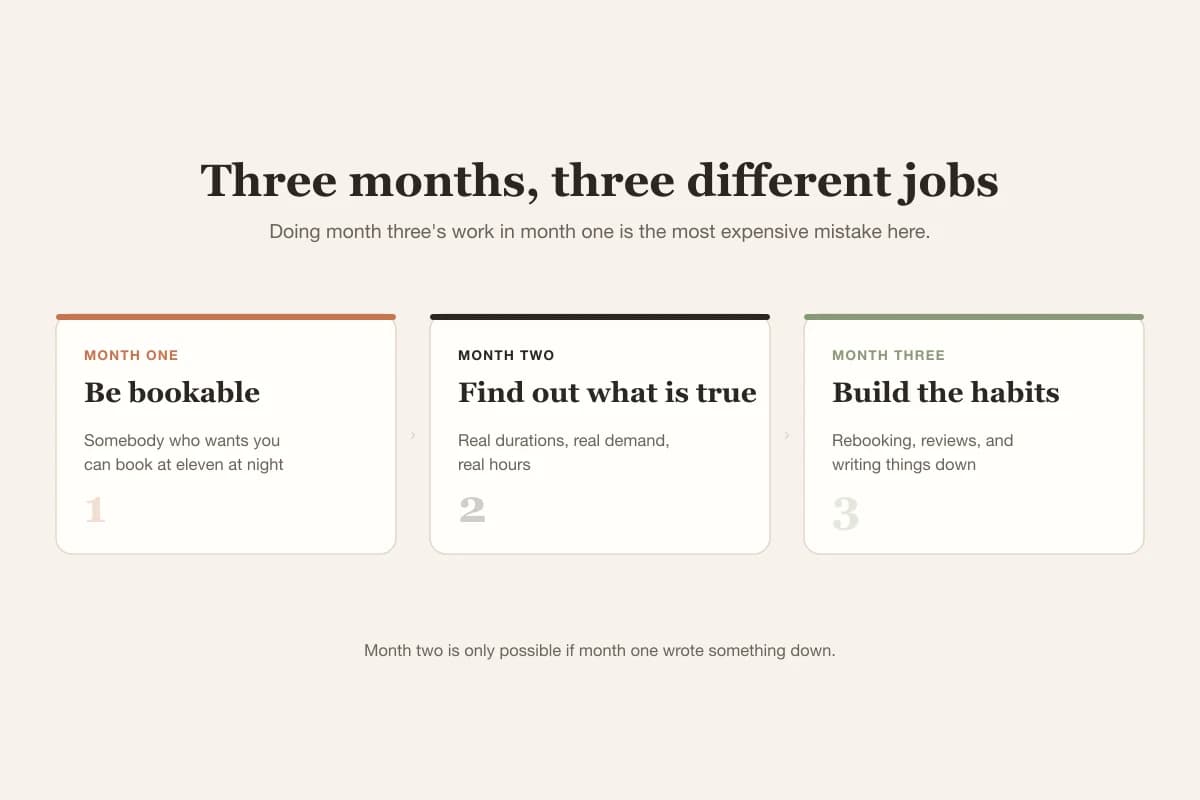
Month one is about being bookable. Somebody who wants an appointment must be able to get one, at eleven at night, without reaching you.
Month two is about finding out what is true. How long things actually take, who actually comes, and what people actually ask for.
Month three is about keeping them. The habits that turn a first visit into a second one, which is where a salon is really made.
Almost every new salon spends month one on decisions that belong in month three, and month three finding out things it could have known in month two.
Day one: the short list
Six things, and everything else can wait until you have opened.
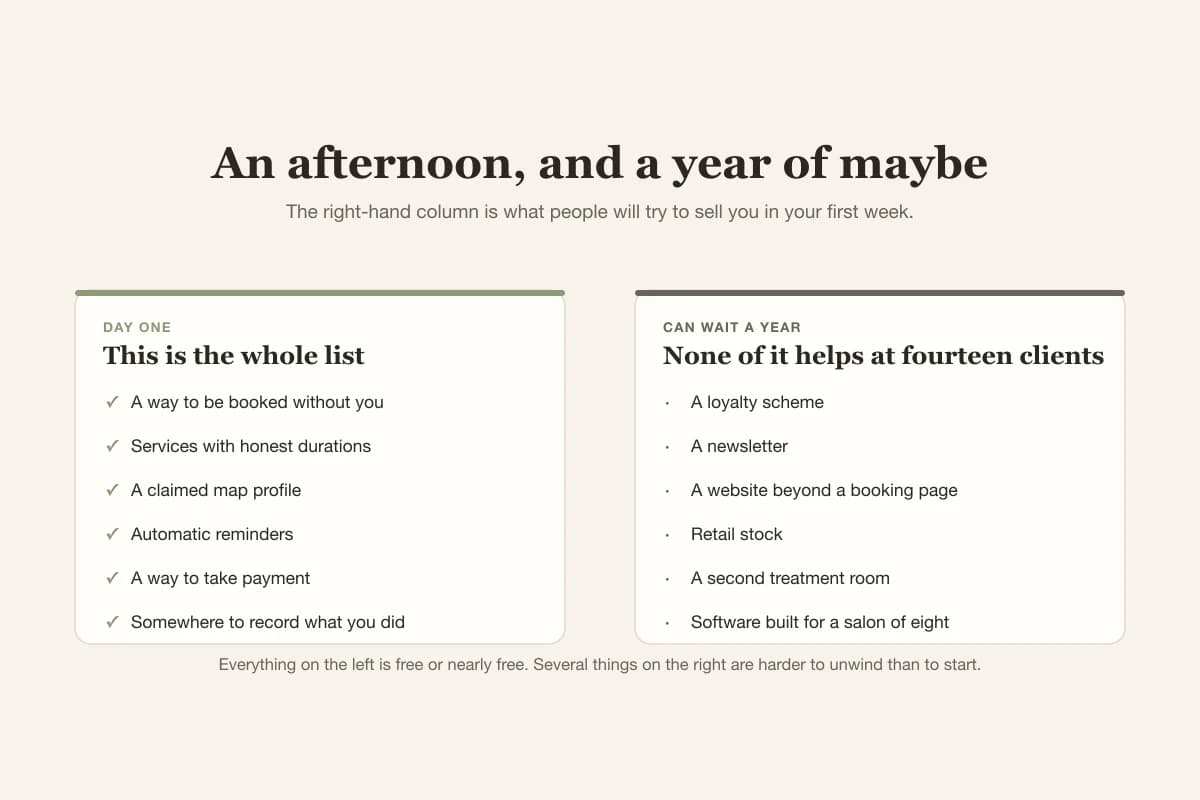
- A way to be booked without you. Any system with a link. This is the only genuinely urgent piece of software.
- Your services with honest durations, including setting up and clearing down rather than only the work.
- A claimed map profile, with the pin on the actual door and the opening hours right.
- Automatic reminders, on from the first appointment rather than added when no-shows start.
- A way to take payment that does not depend on anyone remembering to bring cash.
- Somewhere to write down what you did, even if it is basic, because month two depends on month one having recorded something.
That is the whole list. Everything in it is free or nearly free, and all of it takes an afternoon.
Month one: be findable and be bookable
The only measure that matters in the first month is whether somebody who wants you can complete a booking.
Test it yourself, from a phone, in a private window, as a stranger. Most new salons have never done this.
The map profile is the highest-return hour of the month, because it reaches people who were not looking for you.
Fill in the services list properly rather than the category alone, which is set out in getting bookings from Google Maps.
One thing worth deciding now rather than later: whether to list on a marketplace.
For a salon with empty hours it is a reasonable trade, and it is the situation where paying per client genuinely makes sense.
Understand what it costs before you list, and set a date to review it, using marketplace or your own link.
Month two: find out what is actually true
Everything you decided before opening was a guess, and about a third of it will turn out to be wrong.
Four guesses are worth checking specifically, and all four are checkable from a month of real appointments.
| What you guessed | How to check | What usually turns out |
|---|---|---|
| How long services take | Note the real finish time for a month | Ten to fifteen minutes longer |
| What people book | Count by service | Two services are most of the work |
| When they want to come | Look at the empty blocks | Your hours are wrong at one end |
| What they ask for that you do not offer | Write it down each time | One clear gap emerges |
Fix the durations at the end of month two rather than living with them. Ten minutes a service compounds across a year.
And change your hours if the evidence says so, which for many new salons means later evenings and a quieter morning.
Month three: build the habits
By now you have a small number of clients who have been once. Whether they come again is the whole business.
Three habits, and they are the same three that matter for a salon of twenty years.
Rebook at the chair. One sentence, while she is pleased. This is the single strongest thing in this article.
Ask for a review, at the chair or the same evening, only when somebody has already said something pleased.
Write down the formula or the detail while you are doing the work, because in ten weeks you will not remember.
Reviews matter disproportionately for a new salon, because an empty page is the one thing a stranger cannot get past.
Five real ones take a fortnight of asking, and the method is in how to ask for reviews.
Ask only when somebody has already said something pleased, which in month three happens more often than you will notice.
New clients are unusually generous with a new salon. That goodwill has a shelf life, and it is highest right now.
Money in the first quarter
Not accounting advice, and every situation differs, but three patterns recur often enough to be worth naming.
The gap between busy and paid
A salon can be encouragingly busy in month two and still have almost nothing left after rent, product and whatever you owe.
That is normal at this stage and it is not a sign the salon is failing. It is a sign the fixed costs are spread over too few appointments.
Knowing what an open hour costs makes this much less frightening, and the calculation is in what an empty hour costs.
Buying at the wrong end
The temptation is to spend on the things that are visible: the second chair, the sign, the better basin.
Almost none of those bring a client in. The things that do are free or nearly so, which is genuinely lucky at this stage.
Hold the money for month four, when you will know what you actually need rather than what you imagined you would.
Paying yourself nothing
Common, understandable, and it distorts every number you look at for the rest of the year.
A salon that is only profitable because the owner works unpaid is not profitable, and pricing built on that assumption stays wrong for years.
Put a figure on your own time even if you cannot draw it yet, so that at least the arithmetic is honest.
What not to do
Four mistakes are common enough in a first quarter to be worth naming, and the first is the most expensive.
Do not discount the opening
An opening offer fills the salon with people who came for a price, and the price becomes their reference point forever.
Every future rise is then measured against a number you never intended to charge.
Give something that is not money instead: more time, a treatment added, a consultation nobody else offers.
Do not price by looking next door
Their rent, staff and product costs are invisible to you, and their prices may be a mistake you are about to copy.
Build from your own numbers, which is worked through in pricing per hour rather than per service.
Do not buy a system you will grow into
Software for a salon of eight, bought by a salon of one, is a fortnight of setup for features nobody uses.
Start with something free and permanent, and move when a limit actually gets in the way rather than when you imagine it might.
Do not open every hour
Being open is a cost. Twelve hours a day in month one produces long empty afternoons and a person too tired to be good in the evening.
Open shorter and extend once the evidence says where the demand actually is, which month two will tell you.
Adding hours later reads as a salon doing well. Removing them reads as a salon struggling, even when it is the same decision.
That asymmetry is worth respecting, because opening hours are one of the few things clients genuinely notice changing.
The week before you open
One section out of chronological order, because it is the part people wish they had read afterwards.
Four things done in the week before opening make the first month noticeably easier, and none of them involve equipment.
Book a real appointment through your own system, from a phone, as a stranger, and then cancel it and read both messages.
Decide your hours and block what you are protecting, before anyone can book. A system that says yes on Sunday will keep saying yes.
Write the two messages you will send most, the confirmation and the reminder, in your own words rather than the defaults.
Tell the people who already know you, individually rather than as an announcement, because the first fortnight comes from them.
That last one is the whole opening plan for most salons, and it works better than anything paid.
A message to twenty people who already like your work fills more of a first week than any post reaches.
What ninety days should leave you with
Not a full book. Almost nobody has one at ninety days, and expecting it is how people conclude too early that it is not working.
What you should have is a set of true numbers and three working habits.
- Real service durations, corrected from a month of evidence rather than guessed.
- Hours that match when people want to come, rather than when you assumed.
- A handful of genuine reviews, which is what gets a stranger past an empty page.
- A rebooking habit, so first visits turn into second ones without a campaign.
- Some idea where clients found you, which decides where the next year's effort goes.
That last one is worth a note on the record at every first appointment, and it takes two seconds.
In a year it is the difference between knowing what works and repeating everything in the hope that something does.
And if ninety days leaves you with none of that, the honest reading is usually that month one was spent on the wrong things.
That is recoverable in a fortnight, which is worth saying, because at ninety days it rarely feels recoverable at all.