

Booksy works. Most salons that leave it are not leaving the software, they are leaving a subscription that starts around €45 a month.
For a full salon that is a fair price. For one person with a chair, it is €540 a year before the first client sits down.
The seven below do the same job and charge for it in four different ways. Knowing which way suits you matters more than any feature list.
The four ways this gets charged
- A flat subscription. Same price whether you take ten bookings or three hundred. Predictable, expensive when quiet.
- Commission on new clients. Cheap software, and the platform takes a cut of everyone it introduces.
- Free with paid tiers. A real free plan with a stated limit, and a price when you cross it.
- Free software, paid payments. No subscription, but a percentage of every card transaction.
Nothing on this page is outside those four. Decide which model fits your month before you compare a single feature.
The seven, side by side
| Platform | From | Commission | Free plan | Availability |
|---|---|---|---|---|
| Abeautella | €0, then €10 | None | Permanent, 30 bookings a month | Wide, 7 languages |
| Fresha | About €20 | 20% of a new client's first visit | Software free, marketplace not | Wide |
| Setmore | €0, then about €12 per user | None | Yes, limited | Wide |
| SimplyBook.me | €0, then tiered by booking volume | None | Yes, small booking limit | Wide |
| Square Appointments | €0 at base | Card processing only | Yes, single user | Wide |
| GlossGenius | About €22 | Card processing about 2.6% | No | Selected markets |
| Vagaro | About €28, per calendar | None on bookings | No, trial only | Selected markets |
Booksy sits above every row of that table on subscription, and below several of them on commission, which is exactly the trade it offers.
What a solo specialist pays in a year
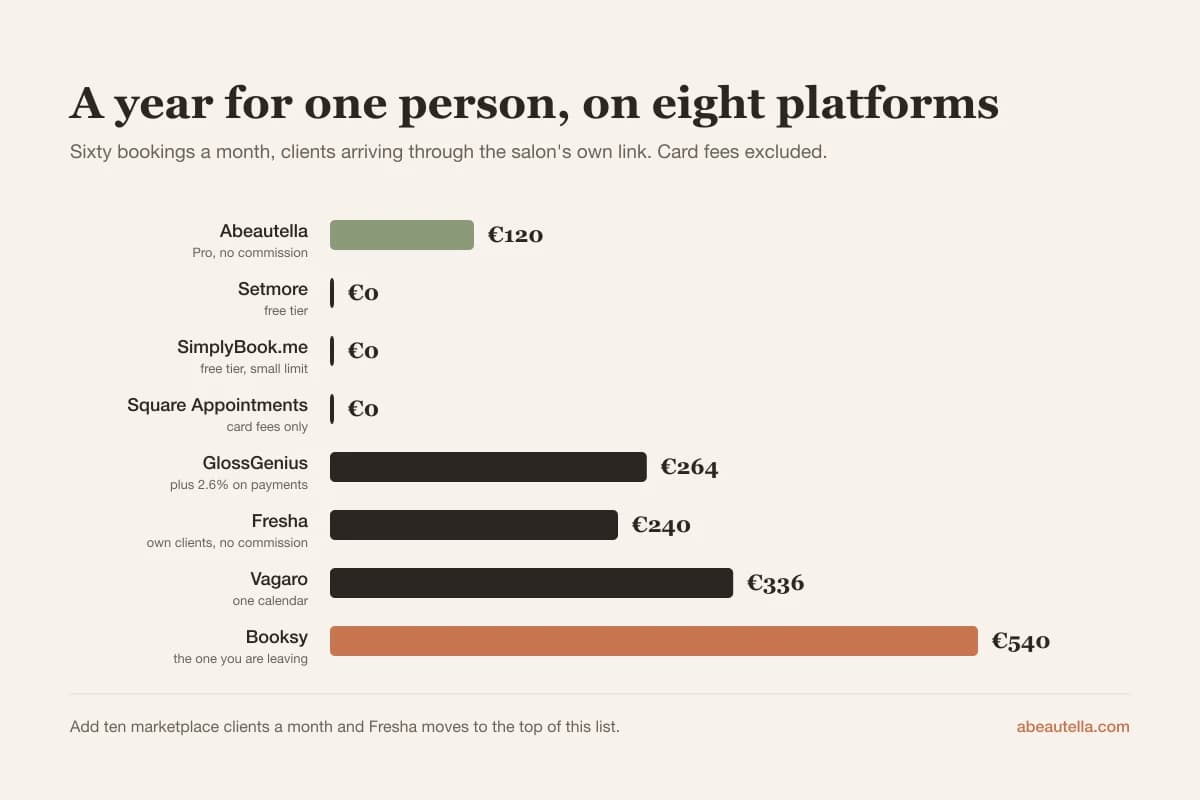
One person, sixty bookings a month, clients arriving through their own link. On that shape, the spread runs from nothing to €540.
Change the shape and the ranking changes with it. Ten marketplace clients a month moves Fresha from the cheap end to the expensive one.
The seven, one at a time
Abeautella
Ours, so read this with that in mind. Free permanently for one person up to thirty bookings a month, then €10, and no commission at any tier.
Where it loses: there is no marketplace. Nobody is introduced to you, so if you have no clients yet, we do not solve that.
It fits a solo specialist or a small team who already have a following and want the calendar to cost almost nothing.
Fresha
The cheapest subscription with the largest marketplace attached. Around €20 a month, then 20% of a new client's first booking.
Where it loses: the commission has a floor of about €6, so on cheap services the effective rate climbs above a fifth.
It fits a salon that needs clients more than it needs software. We work the arithmetic out in what Fresha's commission costs.
Setmore
One of the few with a genuine free tier and a low paid tier. Around €12 per user once you outgrow it, with no commission.
Where it loses: it is a general appointment tool, not a beauty product. No colour history, no separate duration for a first consultation.
It fits a freelancer whose services are simple and whose calendar is the only thing they need.
SimplyBook.me
Free at a small booking volume, then priced in tiers as the volume grows. Highly configurable, with features sold as separate modules.
Where it loses: the configurability is the cost. Setting it up properly takes an afternoon rather than ten minutes.
It fits someone with unusual booking rules who is willing to spend the time to encode them.
Square Appointments
No subscription at the base tier. Square earns from processing your card payments instead, which is a real cost on a full book.
Where it loses: it is a payments company that also does booking. The beauty-specific parts are thin or absent.
It fits a business already taking payments through Square, where adding the calendar costs nothing extra.
GlossGenius
Built for beauty, flat monthly pricing from around €22, and card processing at roughly 2.6% on top.
Where it loses: availability is limited to selected markets, and the processing fee applies to every paid booking, not only new clients.
It fits a salon in a market where it operates, that wants one bill covering both software and payments.
Vagaro
Priced per calendar from around €28, so a three-chair salon pays roughly three times the headline. No commission on bookings.
Where it loses: several of the useful pieces, marketing and forms among them, are sold as separate monthly add-ons.
It fits a mid-sized salon that wants depth and is prepared to pay per chair for it.
What Booksy does better than most of them
An article about alternatives owes the incumbent a fair hearing, so here is the case for staying, made properly.
The billing is genuinely predictable. One figure a month, no percentage of anything, and promotion is a switch you control rather than a default.
The client-facing app is polished, and clients already have it. Rebooking takes two taps for someone who has used it before.
And it is built for this trade, not adapted to it. Durations, staff calendars and deposits behave the way a salon expects, without configuration.
If your book is full and the fee per booking is small, none of the alternatives here will improve your day. They will only lower your bill.
The costs that are not in the table
Card processing applies to everything
A commission on new clients hits a few bookings. A processing fee hits every paid one, which on a full book is the larger number.
Compare the two properly: two per cent of your whole year against twenty per cent of a handful of first visits.
Per-user and per-calendar pricing
A headline price for one person tells you nothing about a three-person salon. Multiply before you compare.
Add-ons
Reporting, marketing and forms are sometimes separate line items. Check whether the feature you are switching for is included in the tier you priced.
What to test, beyond the price
Price gets you a shortlist of two or three. These five things decide which of them you can actually work in, and none of them appear on a pricing page.
Whether service durations are real
A generic tool gives every service the same slot. A colour salon needs two hours for one appointment and forty minutes for another, with the calendar knowing the difference.
Book a long service and a short one on the same test day. If the calendar treats them identically, it will overbook you within a week.
What the client record remembers
A colour formula, a contraindication, a note that someone is always ten minutes late. A cosmetics studio cannot work without the second of those.
Check whether notes are searchable and whether they survive an export. A note you cannot take with you is not really yours.
Whether a deposit can be selective
Charging a deposit on everything costs you bookings. The useful version applies it to long services only, or to clients who have missed before.
Several platforms offer deposits as all or nothing. That is a meaningful limitation for a massage studio with a mix of session lengths.
How a freed slot gets offered
A waitlist that you have to work through by hand is a list, not a feature. The question is whether the platform offers the slot on its own.
Whether team calendars are separate
One booking link per salon, one calendar per person. A barbershop with four chairs needs both at once, and not every platform does it cleanly.
What actually moving looks like
Contact details export and import cleanly almost everywhere. That part takes an hour and is not the hard part.
The hard part is that your clients have a habit. Someone who has booked you in the same app twenty times will open it the twenty-first.
Plan for that. Tell people in the chair, put the new link in your bio before you switch, and keep both running for a few weeks.
The bookings that came from a marketplace are the ones you are most likely to lose, because that relationship was never yours to move.
Which one to pick
- One person, own clients, wants it cheap. A permanent free plan, ours or Setmore's, is the honest answer.
- Needs new clients more than software. Fresha, with the commission counted as a marketing budget.
- Already on Square for payments. Try their calendar before paying for a second system.
- Small team, wants predictable billing. A flat subscription with no commission, priced per person.
- Complicated rules and patience. SimplyBook.me will do what the others will not.
- Wants everything and will pay per chair. Vagaro, with the add-ons priced in.
A two week trial that tells you something
Most trials get used to click around the settings. That tells you very little. Run this instead, and you will know by the end of the second week.
- Enter your five most common services, with their real durations and prices. If this takes more than twenty minutes, note that.
- Book yourself as a client, from a phone, from start to confirmation. Count the taps.
- Cancel that booking and see what the client receives. Then see what you receive.
- Put a real client through it, one who will tell you honestly what the message looked like.
- Export everything on the last day of the trial. This is the only way to know the export works before you depend on it.
Step five is the one people skip and the one that matters most. An export button that produces an unusable file is the same as no export button.
Two weeks of that beats two months of reading comparison articles, including this one.
Verdict
Booksy is not overpriced for what it does. It is priced for a salon with staff and a full book, and it is heavy for anyone smaller.
If you are leaving because of the monthly fee, the useful question is not which platform is cheapest. It is which charging model matches your month.
Pick the model first, then pick from the two or three platforms that use it. That order saves you a second migration.