The question is usually asked as whether the salon can afford the wage.
That is the smallest part of it, and answering that question alone is how salons hire at the wrong moment.
The cost is larger than the wage, and the difficult part is not the monthly figure at all.
It is the ramp: the months before a new person is busy, during which you are paying in full for a chair that is half empty.
What a person actually costs
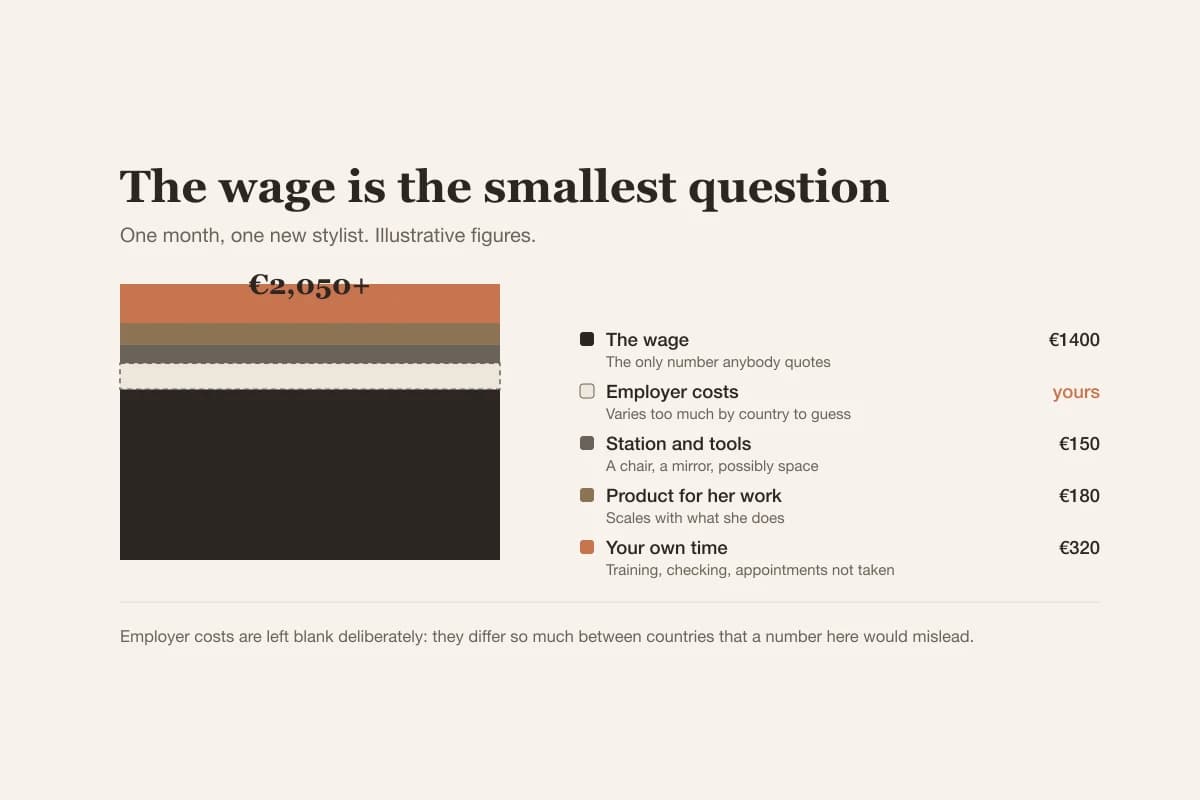
Five things, and most salons count the first and part of the second.
The wage itself, which is the only number anybody quotes.
Employer costs on top of it, which differ so much between countries that no article should give you a percentage. Ask your accountant for yours.
A station, which is a chair, a mirror, tools, and possibly rent for space you did not previously need.
Product, which scales with her work and is easy to forget when thinking in monthly terms.
Your own time, which is the invisible one: training, checking, and the appointments you do not take because you are supervising.
That last item is real money and it is at its largest in exactly the months when she is earning least.
The ramp is the real question
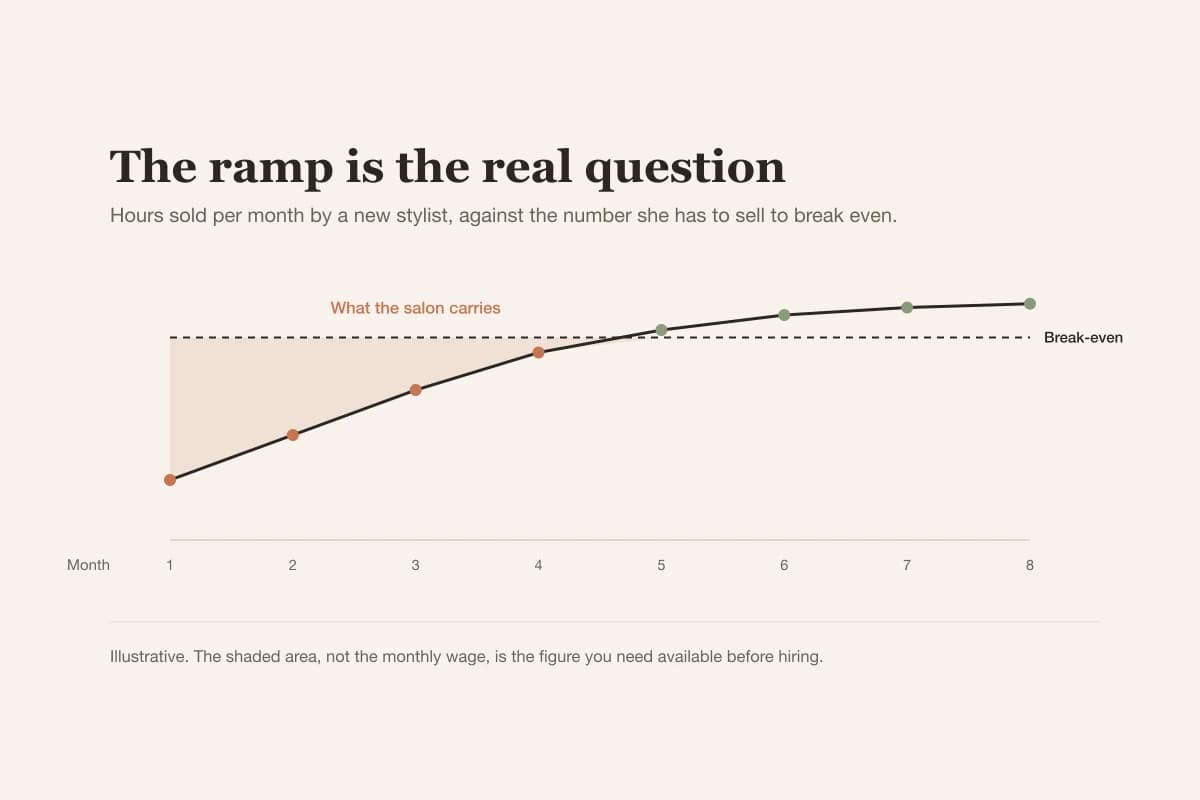
Nobody arrives with a full book. Even somebody bringing clients brings a fraction of them, and later than she expects.
A realistic shape is a quarter full in the first month, half by the third, and something near break-even at four or five.
The total cost of that period is what you actually need to be able to carry, and it is usually two to four months of the full monthly figure.
This is the number that decides the answer, and it is not the number most people calculate.
A salon that can pay the monthly cost but has nothing spare cannot afford this hire, even though the monthly arithmetic works.
Two things shorten the ramp genuinely, and both are worth weighing before the wage is discussed.
Somebody who brings a book. Expect a third of what she describes, arriving over several months rather than in week one.
Overflow you can hand over immediately. If you are already turning work away, she starts at half rather than at a quarter.
The second is worth more than the first and it is the one you can verify before hiring anybody.
The signals you are actually ready
Feeling busy is not one of them, and it is the signal most salons act on.
Four things point to genuine capacity pressure rather than a tiring month.
| Signal | What it means | How to check |
|---|---|---|
| Turning work away | Real demand you cannot serve | Count it for a month, do not estimate |
| Booked out three weeks | Consistently, not in December | Look at your own lead time |
| Your best hours full for months | Structural, not seasonal | Occupancy by day and hour |
| Refusing new clients | The strongest signal there is | You will know |
Count turned-away work for one month with a mark on a piece of paper. The number is nearly always lower than the feeling.
And check whether the pressure is in every hour or only in the good ones, because a full Saturday with an empty Tuesday is not a staffing problem.
Where those empty hours are, and what they cost, is worked through in what an empty hour costs.
The cheaper things to try first
Three of these can add real capacity without hiring anybody, and all three are reversible.
Recover the time you already have
Ten minutes shaved from your three most common services is close to an extra appointment a day.
For a colour salon, scheduling processing time properly is the largest version of this and it can be worth a third of a day.
The mechanics are in software for hair salons, and it costs nothing to change.
Raise prices instead
If you are turning work away, the market is telling you something about price before it tells you something about staffing.
A rise of five to ten per cent on a full book is more money with no ramp, no risk, and no additional person to manage.
Rent the chair instead of filling it
A self-employed renter carries her own risk, brings her own clients, and costs you nothing in the months she is quiet.
You gain less, because her clients are hers rather than the salon's, which is a real trade rather than a free lunch.
For many salons at this stage it is the right first step, and it can become employment later. What to settle first is in scheduling a salon team.
An assistant is a different calculation
The instinct is to hire another person who does what you do. Often the better hire does the parts you should not be doing.
An assistant costs less, ramps faster, and adds capacity to the people already there rather than needing her own book.
In a colour salon this is particularly clear: somebody handling rinses and preparation can add an appointment a day to each stylist.
The arithmetic is easier too, because you are not waiting for her to be discovered by clients.
She breaks even the moment the existing team sells the hours she frees, which is usually within weeks rather than months.
The catch is that it only works if the team is genuinely at capacity, since freed hours have to be sellable to be worth anything.
So the same test applies: count what you turn away, rather than deciding from how the week felt.
What changes besides the money
The financial question is the one people ask. The one that catches them out is what the job becomes afterwards.
Four things change on the day somebody else works in your salon, and none of them appear in any calculation.
Your own hours become the flexible ones. Somebody has to open, cover the quiet Tuesday, and be there when she is ill.
Your standard becomes something you have to describe. Things you do without thinking now have to be explained, twice.
The client relationship changes. Some of your regulars will end up with her, and that is the point rather than a failure.
You become responsible for somebody's income, which is a different weight from being responsible for your own.
None of that is an argument against hiring. It is the part that decides whether you enjoy the salon afterwards.
Owners who regret hiring almost never regret the arithmetic. They regret that the work stopped being the work they liked.
When the answer is no
It is a perfectly good answer, and the useful part is knowing what to do with it rather than treating it as a failure.
Write down what would change your mind. A specific number, so the decision has a trigger rather than a mood.
Turning away eight bookings a month for three consecutive months is a trigger. Feeling stretched is not.
Then work on the cheaper things in the meantime, because most of them also make the eventual hire easier.
A salon with accurate durations, sensible prices and a full Tuesday is a salon a new person can be busy in.
And revisit it on a date, not when you next have a hard week, because hard weeks are the worst moment to decide anything.
Six months is a reasonable interval. Put it in the calendar with the number attached, and let the evidence answer it.
The arithmetic, worked
| A month | |
|---|---|
| Wage | €1,400 |
| Employer costs, whatever yours are | Your figure |
| Station, tools and space | €150 |
| Product for her work | €180 |
| Your time, at your own hourly rate | €320 |
| Total, before employer costs | €2,050 |
At €38 a sold hour after product, €2,050 needs about fifty-four sold hours a month, or roughly thirteen a week.
That is a little over a third of a full-time week, which sounds achievable and is, by around month four.
The months before that are the cost of the decision, and adding them up gives you the figure you actually need available.
Do it with your own numbers before anything else. It takes twenty minutes and it is a different conversation afterwards.
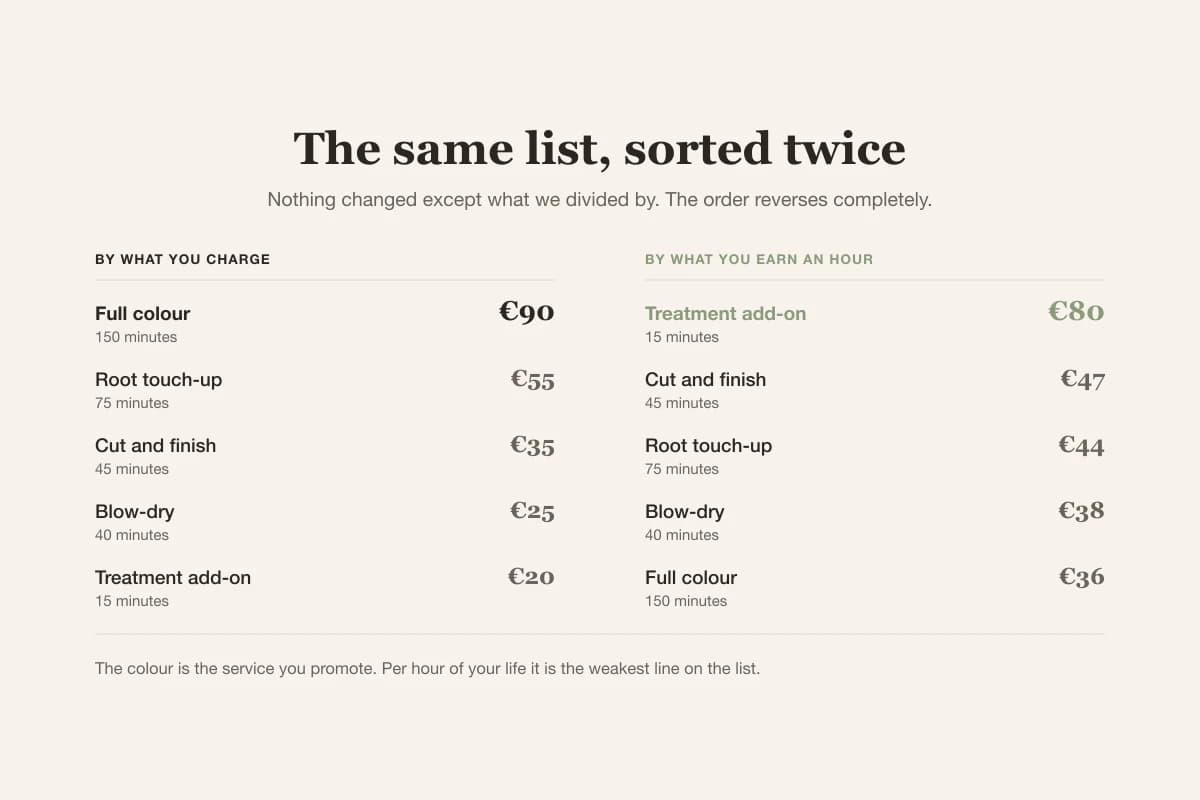
One line in that table is worth checking rather than accepting: what a sold hour actually brings in after product.
Most salons use their headline price, which overstates it, and the error runs through every other number here.
The method is in pricing per hour rather than per service, and it takes an evening.
How to make the ramp shorter
The decision is mostly settled by how quickly she fills, so it is worth knowing what actually affects that.
- Make her bookable from day one, with her own availability on your booking page rather than through you.
- Default to any available specialist, so new clients reach her instead of waiting three weeks for you.
- Give her your overflow deliberately, particularly the services you least want to be doing.
- Put her on the map profile and in your photographs, because a face nobody has seen is a face nobody books.
- Start her in your busiest hours, not the quiet ones, which is the opposite of what most salons do.
The second and the fifth are the ones that change the shape of the curve most, and both are free.
Most salons put a new person in the empty hours to fill them, which guarantees she stays empty and demoralised.
Put her where the demand is and take the quiet hours yourself for a few months. It is the single fastest way to shorten the ramp.
It is also the least comfortable, because it means giving away the hours you enjoy most while carrying the ones you do not.
Two or three months of that is what turns a hire from an expense into a colleague, and it is the part nobody warns you about.
The alternative, protecting your own book and giving her the leftovers, produces somebody quiet, discouraged, and gone by month six.