


You know what a colour brings in. You probably know what your rent is.
Very few salons can say what one empty hour costs, and it is one of the more useful numbers a business can have.
It is also not the number most people reach for. The instinct is to count the lost sale, which is the wrong half.
This works out the right one, and then what to actually do about it.
Why the lost sale is the wrong number
An empty hour did not cost you a €60 colour, because that colour was never booked.
What it cost is everything that ran during that hour regardless: rent, heat, light, wages, software, insurance.
That money left whether or not anyone sat down, which is what makes it a real cost rather than a hypothetical one.
The distinction matters because it changes what you should be willing to do to fill the hour.
If you think an empty hour cost €60, a €30 discount looks like a loss. If you know it cost €5.20, the same discount looks obvious.
One of those beliefs keeps a chair empty. The other fills it.
The calculation
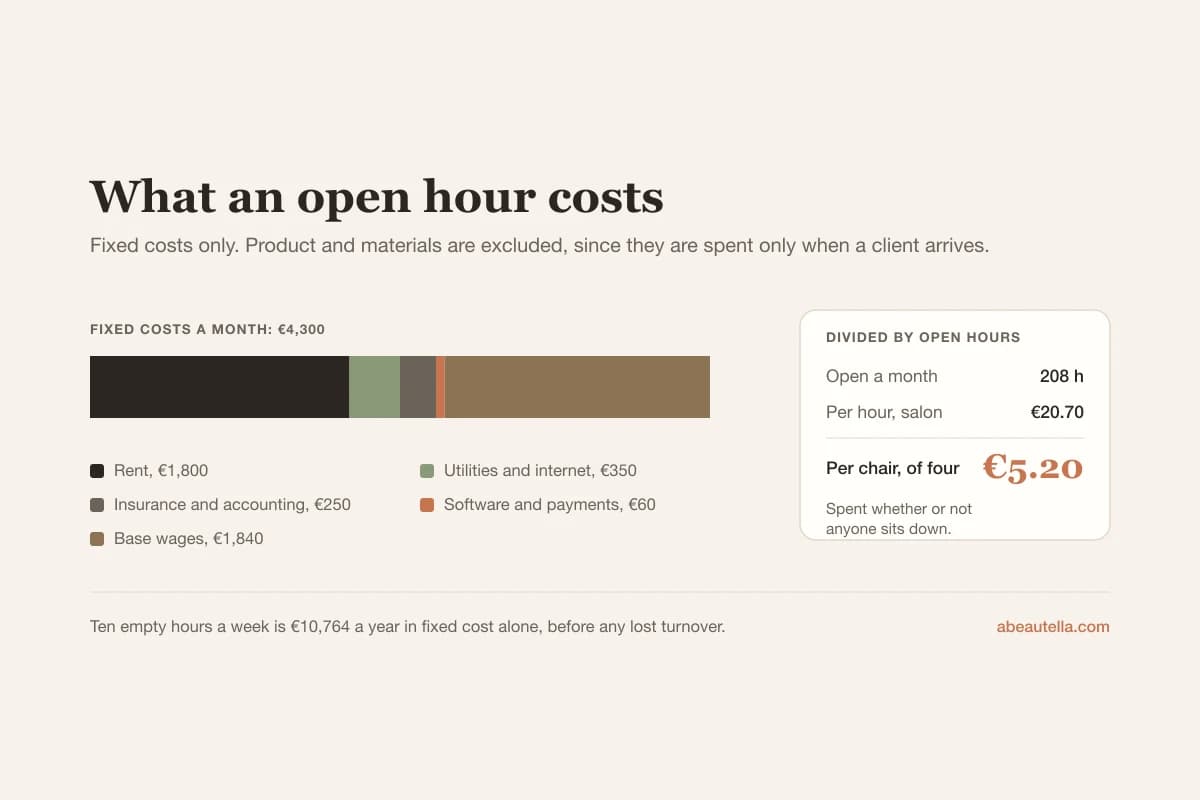
Two numbers, one division. It takes ten minutes and you only need to do it once a year.
- Add your monthly fixed costs. Rent, utilities, insurance, software, and any wage you pay whether or not clients arrive.
- Count the hours you are open in a month. Twelve hours a day, four days, plus weekends. Be honest rather than optimistic.
- Divide the first by the second. That is what every open hour costs before a single client walks in.
- Do it per chair if you have staff, because an empty chair in a full salon is a different problem from a quiet day.
| Fixed cost | A month |
|---|---|
| Rent | €1,800 |
| Utilities and internet | €350 |
| Insurance and accounting | €250 |
| Software and payments | €60 |
| Base wages, independent of bookings | €1,840 |
| Total | €4,300 |
Your numbers will be different. The method is the same and the conclusion usually is too.
Most salons find the figure is small per chair and startling per week, which is exactly the right way round to be surprised.
One thing to keep out of the calculation: product and materials, which are only spent when a client is actually there.
Those are variable costs. Including them inflates the figure and makes an empty hour look worse than it is.
What that number is actually for
It is not for feeling bad about quiet days. It is a floor, and floors are useful for three specific decisions.
What a filled hour is worth
Anything above the floor is better than empty. A €25 service in an hour that costs €5.20 is €19.80 you did not have.
That is not an argument for discounting everything. It is an argument for discounting the hours nobody was going to book anyway.
Whether to open at all
Eight hours open on a Monday costs €166 in fixed cost. If Monday reliably brings in €120, it is not a quiet day, it is a subsidised one.
Closing a day is a serious decision and this is the number it should be made with, rather than a feeling about footfall.
What a no-show costs
A no-show is worse than an empty hour, and the difference is precise: it also consumed the slot somebody else could have booked.
So the cost is the fixed cost plus the sale that was actually agreed. That is the argument for deposits, worked through in nine methods against no-shows.
Most empty hours are not random
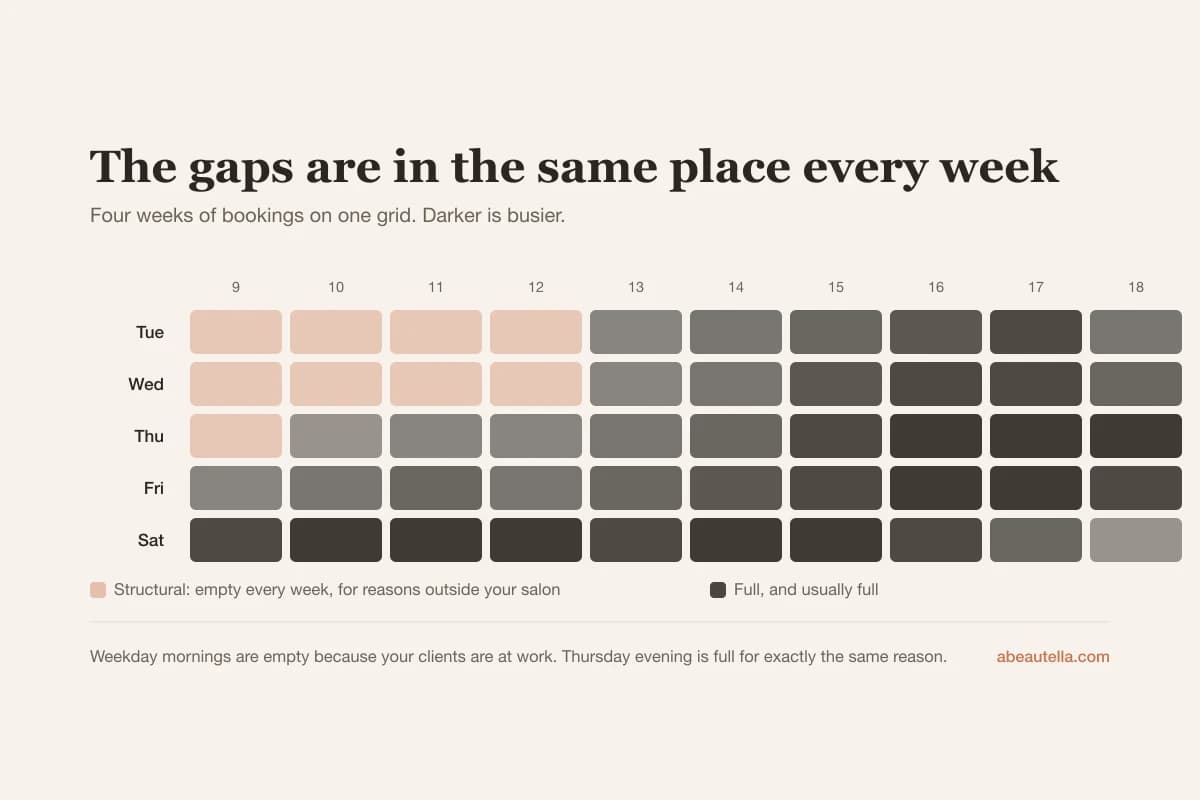
Plot a month of bookings on a grid and the gaps stop looking like bad luck.
The same blocks are empty every week, and they are empty for reasons that have nothing to do with your salon.
Weekday mornings are empty because your clients are at work. Thursday evening is full for exactly the same reason.
That distinction is the whole of what follows, because structural gaps and random gaps need opposite treatments.
| Structural gap | Random gap | |
|---|---|---|
| Looks like | The same hours, every week | A cancellation, a quiet afternoon |
| Caused by | When your clients are available | Chance |
| Fixed by | A different offer, or different hours | A waiting list |
| Discounting helps? | Yes, if aimed only at that hour | No, it just moves bookings |
Filling the structural gaps
These are the ones worth real effort, because they repeat and so does anything that works on them.
The principle is narrow: change the offer for that hour only, and make the restriction explicit rather than implied.
- A different price for a named window. Tuesday and Wednesday before noon, not a general discount that anyone can use.
- A different audience. People who are free on weekday mornings are a real group, and they are not your Saturday clients.
- A different service. Shorter treatments, or the ones that suit somebody stopping in during a working day.
- Training and model work, which turns a genuinely dead hour into something that improves the salon.
- Fewer open hours. If a morning never fills, the cheapest fix is not opening for it.
The last one is unpopular and often correct. Being open is a cost, and it is the one cost people forget is optional.
Whatever you try, change one thing and give it six weeks. A structural gap took years to form and will not move in a fortnight.
Filling the random gaps
These need speed rather than strategy, because a cancellation at ten for a two o'clock slot has four hours of useful life.
The only thing that reliably works is a list of people who already said they wanted an earlier appointment.
Ask every client who books more than three weeks out whether she would take something sooner. Most say yes and are pleased to be asked.
Then when a slot opens, you are contacting people who have already agreed rather than advertising into silence.
A waiting list of fifteen names fills more short-notice gaps than any social post ever will, and the software can hold it for you.
And it costs nothing, which matters when the hour you are filling only cost €5.20 in the first place.
What a year of empty hours adds up to
The per-hour figure is deliberately small. The point is what happens when you multiply it.
| Empty hours a week | A month | A year | At €20.70 an hour |
|---|---|---|---|
| 5 | 22 | 260 | €5,382 |
| 10 | 43 | 520 | €10,764 |
| 15 | 65 | 780 | €16,146 |
Ten empty hours a week is two hours a day, which most salons would describe as a normal week rather than a bad one.
That is nearly €11,000 a year of cost with nothing on the other side of it, which is many times what any booking system costs.
You will not get to zero and should not try. Some slack is how a salon absorbs an overrun without running late all afternoon.
But the difference between fifteen empty hours and eight is a genuine salary, and it is usually made of the same three repeating blocks.
The same number decides your prices
Once you know what an hour costs, a second calculation becomes possible and most salons have never done it either.
Prices in this trade are usually set per service, by looking at what the salon down the road charges.
The useful version is per hour, because an hour is the thing you actually sell and the thing you run out of.
Take each service, divide the price by how long it really occupies you, and put the results next to each other.
| Service | Price | Time it takes | Per hour |
|---|---|---|---|
| Cut and finish | €35 | 45 minutes | €47 |
| Full colour | €90 | 2 hours 30 | €36 |
| Root touch-up | €55 | 1 hour 15 | €44 |
| Treatment add-on | €20 | 15 minutes | €80 |
Almost every salon that does this finds the same thing: the expensive service is not the profitable one.
A €90 colour feels like the best thing in the book. Per hour it earns less than a €35 cut and far less than a short add-on.
That does not mean stop doing colour. It means know which services deserve the promotion and which are already earning.
What occupancy should you aim for
The instinct is a hundred per cent. That is the wrong target and chasing it makes a salon worse.
A completely full book has no room for an overrun, a walk-in, a regular in a hurry, or a colour that needs another twenty minutes.
One appointment running late at ten in the morning then makes every client that day wait, which is how a good salon gets bad reviews.
Somewhere in the region of eighty per cent is where most salons run comfortably and profitably at the same time.
The remaining fifth is not waste. It is what absorbs reality, and it is also where a client who calls today can be fitted in.
So the goal is not zero empty hours. It is empty hours in the right places, spread through the week rather than clumped on a Tuesday.
Where to start this week
- Do the division. Fixed costs, open hours, one number. Ten minutes, once a year.
- Plot four weeks of bookings on a grid. The structural gaps will be obvious and they will surprise you.
- Pick the worst repeating block and change one thing about it. Price, service, or audience.
- Start a waiting list with the next client who books three weeks out. One question, asked at the chair.
- Recount in three months and see which of the two problems you actually had.
Most salons discover their structural gaps are worth more attention than their random ones, and they had been treating only the random ones.
A cancellation is visible and annoying. A Tuesday morning that has been empty for three years is invisible and costs far more.
That is the pattern worth noticing generally. The problems that announce themselves are rarely the expensive ones.
Nobody walks into the salon and tells you about the hour that never got booked, so it never reaches the list of things to fix.
Doing the division once a year is how it gets onto that list, and ten minutes is a fair price for the information.