Nearly every salon that asks about deposits asks the same question, and it is the wrong one.
Should we take deposits, yes or no. Framed that way there is no good answer, because both answers are expensive.
A deposit on everything loses bookings from people who would have turned up. No deposit at all leaves your longest days unprotected.
The useful version is four separate decisions: which services, which clients, how much, and how you ask.
Why a blanket deposit costs you money
Asking for a card before a €25 fill introduces friction into a booking that had almost none.
Some people abandon at that step. Not because they intended to miss the appointment, but because it became a task rather than a tap.
You will never see those bookings. They do not appear as cancellations or complaints, they simply do not exist.
That is what makes a blanket policy so easy to keep: the cost is invisible and the benefit is visible.
Meanwhile the bookings it protects are mostly ones that were never at risk. Your Thursday regular of six years was going to come.
Which services actually need one
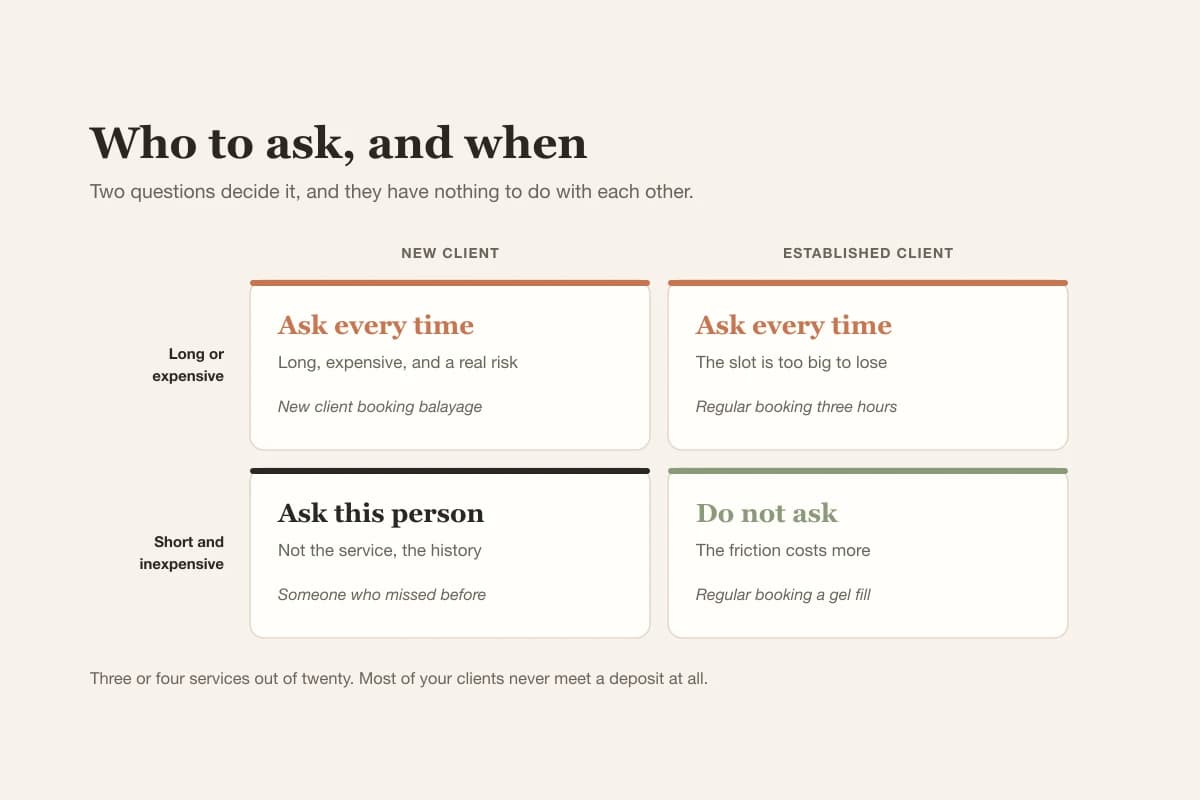
Two things decide it, and they are independent of each other.
How much the slot is worth, which is the price and the length together. Three hours at €140 is a different loss from thirty minutes at €25.
How likely the miss is, which depends far more on the person than the service.
Put them on two axes and the answer stops being a policy and starts being a short list.
| Service | Slot value | Ask for a deposit? |
|---|---|---|
| Balayage, three hours | High | Always |
| Full colour, two hours | High | Always |
| Lash extensions, two hours | High | Always |
| Cut and finish, 45 minutes | Moderate | Only if she has missed before |
| Gel fill, 30 minutes | Low | No |
| Brow tidy, 15 minutes | Low | No |
This list usually covers three or four services out of a price list of twenty.
Which means most of your clients never encounter a deposit at all, and the ones who do are booking something significant.
Which clients, and how to decide
The second axis is the one salons avoid, because it feels like keeping a list of who is trustworthy.
It is not that. It is noticing what already happened, which is different from judging anybody.
Three groups behave differently enough to be worth separating.
- Established regulars. Almost never miss. Asking them for a deposit is the fastest way to make a good relationship feel transactional.
- Brand new clients. Higher risk, because nothing binds them yet and they may have booked three salons the same evening.
- Anyone who has missed once without warning. By far the strongest predictor, and the only group where a deposit on anything is fair.
The third group is small. In most salons it is under five per cent of the client list and it accounts for most of the losses.
Targeting them specifically protects the day without touching the ninety-five per cent who never caused a problem.
The mechanics matter here: your software has to let you require a deposit from one person and not another, which not all of them do.
How much to ask for
Small enough not to be a barrier, large enough to be remembered when something else comes up on the day.
The evidence on commitment points the same way as common sense: the amount matters much less than its existence.
A €20 deposit on a €140 service does almost the same work as a €70 one, and loses far fewer bookings.
| Approach | What it does | What it costs |
|---|---|---|
| A flat small amount, €20 | Simple to explain, easy to say yes to | Barely anything |
| A percentage, 20 to 25% | Scales with the slot you are protecting | Feels large on expensive work |
| The full price up front | Total protection | Loses new clients outright |
| The price of the first hour | Fair-sounding, easy to justify | Needs explaining every time |
Whatever you choose, keep it the same for everybody in the same situation. A deposit that varies by mood reads as arbitrary.
The refund policy is what makes it acceptable
This is the part that decides whether a deposit feels reasonable or insulting, and most salons never write it down.
A deposit with no stated way to get it back is a penalty. A deposit with a clear window is a booking that means something.
Twenty-four or forty-eight hours is the usual line, and either is defensible as long as it is stated before payment.
Say what happens in all three cases: she comes, she cancels in time, she cancels late or does not appear.
And then apply it. A policy you waive for everybody who asks is not a policy, it is a fee on people who are too polite to argue.
One deliberate exception is worth allowing: genuine emergencies, once. That costs you very little and buys a great deal of goodwill.
The wording that works
Most of the awkwardness comes from the phrasing rather than the request, and the phrasing is easy to fix.
What makes it land badly
Anything that explains your reason. Mentioning no-shows tells a client she is being managed because other people behaved badly.
Anything apologetic. Hedging signals that you think the request is unreasonable, which invites her to think so too.
Anything about policy. The word itself makes a salon sound like a utility company.
What makes it land well
State it as part of the booking, in the same tone as the time and the price. It is information, not a negotiation.
Tie it to what she gets: the slot is held for her, and the amount comes off the price on the day.
That second half is the whole trick. A deposit that comes off the bill is not a charge, it is part of the payment moved earlier.
Nothing in that sentence apologises, explains, or mentions anyone who failed to turn up.
What it actually protects
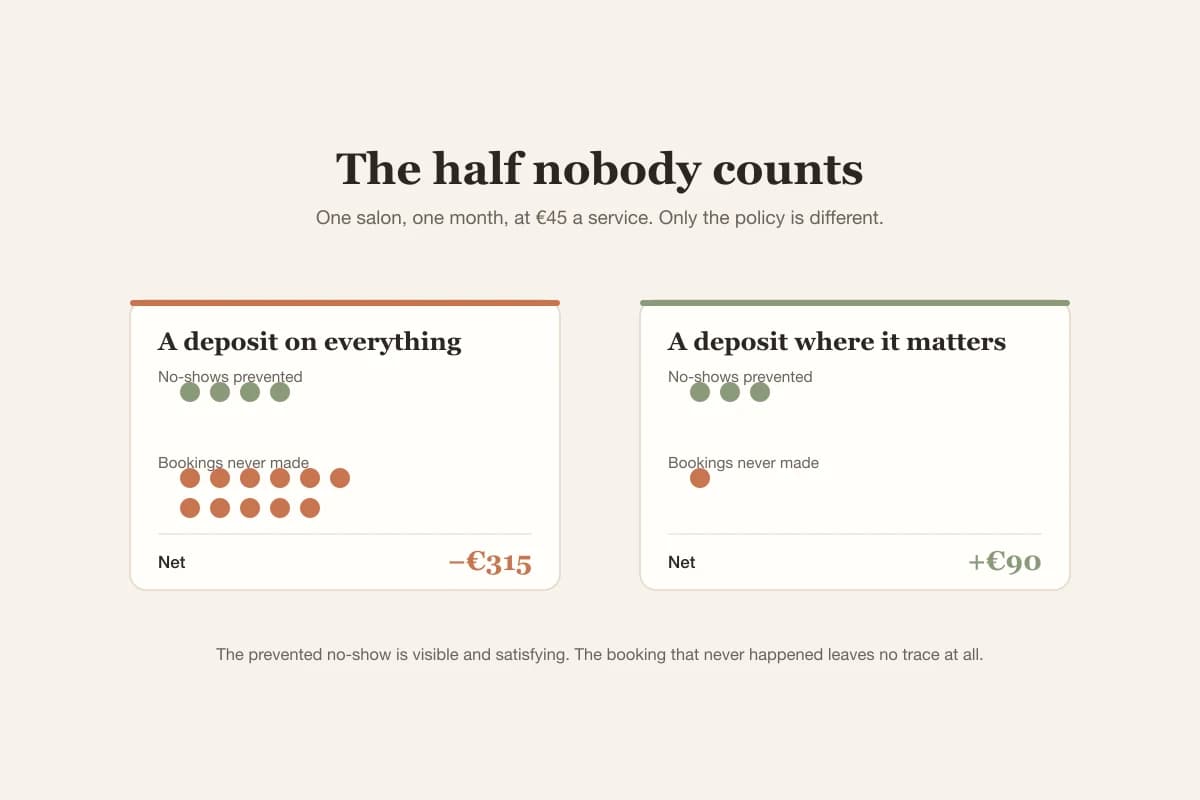
A blanket deposit stops most no-shows and also stops some bookings. The second number is invisible and usually larger.
A targeted deposit stops nearly as many no-shows, because it is aimed at the appointments that were actually at risk.
And it loses almost no bookings, because the people who meet friction are the ones booking something significant.
Someone committing to three hours and €140 is not going to abandon over a €20 deposit. Someone booking a fill might.
The value of an hour saved is worked out in what an empty hour costs, and it makes this arithmetic easier to run on your own numbers.
What to do when someone says no
It happens rarely once the wording is right, but it will happen, and having an answer ready keeps the moment calm.
There are three versions of no, and only one of them is worth changing your mind for.
I would rather not pay online
Usually genuine and usually about the payment method rather than the deposit itself.
Offer to take it in the salon or by transfer. You have lost nothing, because the commitment is what mattered.
I have been coming here for years
Fair, and usually true. If she is a regular she should not have been asked, so this is a signal your rule is set too wide.
Waive it, say so plainly, and then fix the rule rather than making the same exception every month.
I will book somewhere else then
This is the one people fear and the one worth holding your ground on, gently.
Someone unwilling to commit €20 to a three-hour appointment is telling you something useful about that appointment.
Answer once, without defensiveness, and let it go. Chasing this booking costs more than losing it.
Keep track for a few months. If it happens more than once or twice, the amount or the wording is wrong, not the idea.
When a deposit is the wrong tool
It is worth knowing when the answer is something else entirely, because a deposit is not the first thing to try.
If you have no reminders, fix that first. Reminders remove more missed appointments than deposits do and annoy nobody.
If people are booking eight weeks ahead, the problem is the horizon rather than commitment. A confirmation closer to the date does more.
If one person misses repeatedly, a deposit is a workaround for a conversation you should have instead.
And if your no-show rate is under three per cent, do nothing. You do not have this problem and a policy will cost you more than it saves.
The full ladder, from reminders upwards, is in nine methods that reduce no-shows.
Putting it in place this week
- Pick the services. Anything over ninety minutes, or over about €70. Usually three or four out of twenty.
- Pick the amount. A flat €20 is a good default and needs no explaining.
- Write the refund window down, in one sentence, and put it where the client sees it before paying.
- Write the sentence you will say and use exactly the same one every time until it stops feeling odd.
- Add the second rule after a month: anyone who missed without warning now pays a deposit on anything.
Give it three months before judging it. One protected Saturday tells you very little either way.
And count both sides when you do judge it: the appointments it saved, and any booking that stalled at the payment step.
Most salons only ever count the first side, which is why blanket policies survive for years without being questioned.
The saved appointment is visible and satisfying. The booking that never happened leaves no trace at all.
That asymmetry is worth holding in mind whenever a rule seems to be working. The evidence for it is always easier to see than the evidence against.