Every comparison of booking software is written for a business with staff, a reception desk and a budget.
If you work alone, none of those exist. You are the specialist, the receptionist and the person who decides what is worth paying for.
That changes the criteria completely, and it changes which of these five is actually the right answer.
So this list is ordered by two things: whether the free plan expires, and what happens while your hands are busy.
Why free matters more here than anywhere
A salon absorbs €45 a month without noticing. Working alone, that is an hour and a half of work every month, for software.
Most free plans in this category are trials. Fourteen or thirty days, then a card, then a decision made under time pressure.
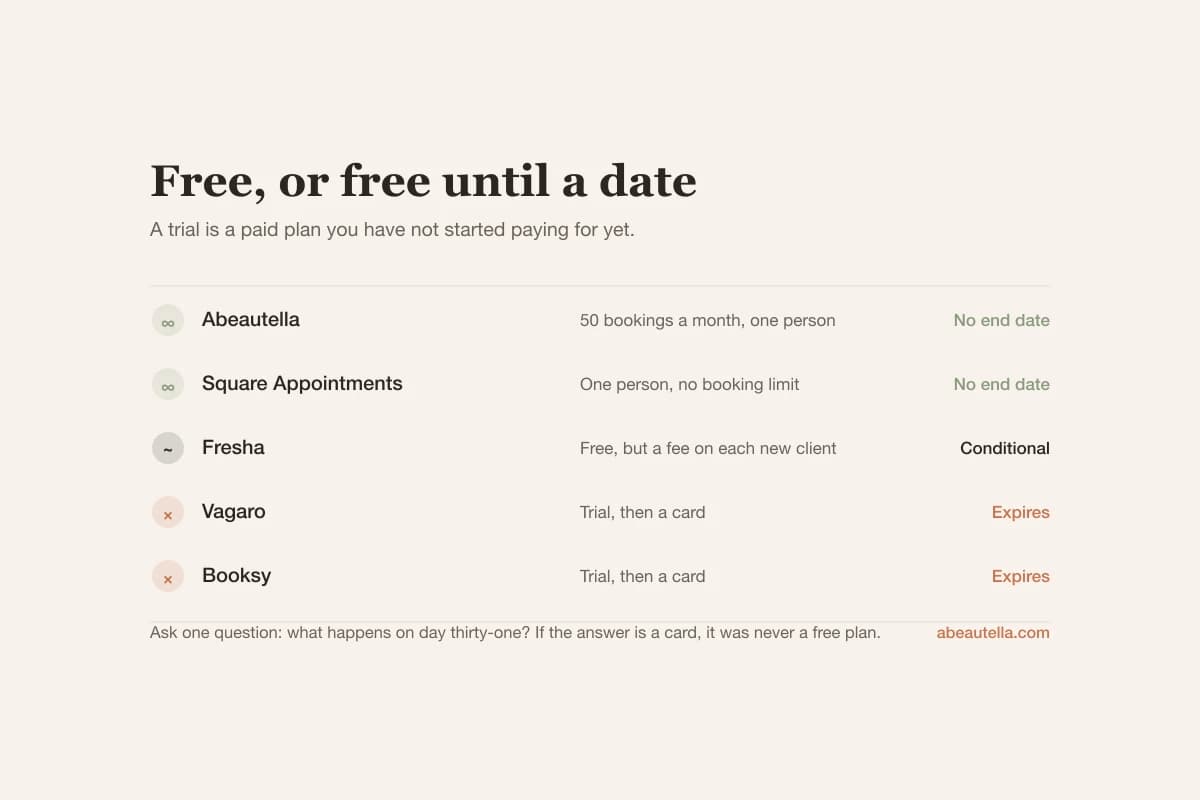
A trial is not a free plan. It is a paid plan you have not started paying for yet, and the difference shows up in month two.
There are only two permanently free options here, and both are genuinely usable rather than a demonstration.
That distinction is worth more than any feature comparison when you are starting, because it removes a deadline from a decision that deserves months.
You can use one for a year, learn what you actually need, and only then pay for the thing you found missing.
The comparison at a glance
| App | Free plan | Then | Commission | Works alone |
|---|---|---|---|---|
| Abeautella | Permanent, 50 bookings | €10 a month | None | Built for it |
| Square Appointments | Permanent, one person | Paid if you hire | None, card fees only | Yes |
| Fresha | Limited | Around €20 a month | €6 minimum per new client | Yes |
| Vagaro | Trial only | From around €25 | Optional promotion | Yes, priced for teams |
| Booksy | Trial only | From around €45 | 30% on Boost, optional | Yes, priced for teams |
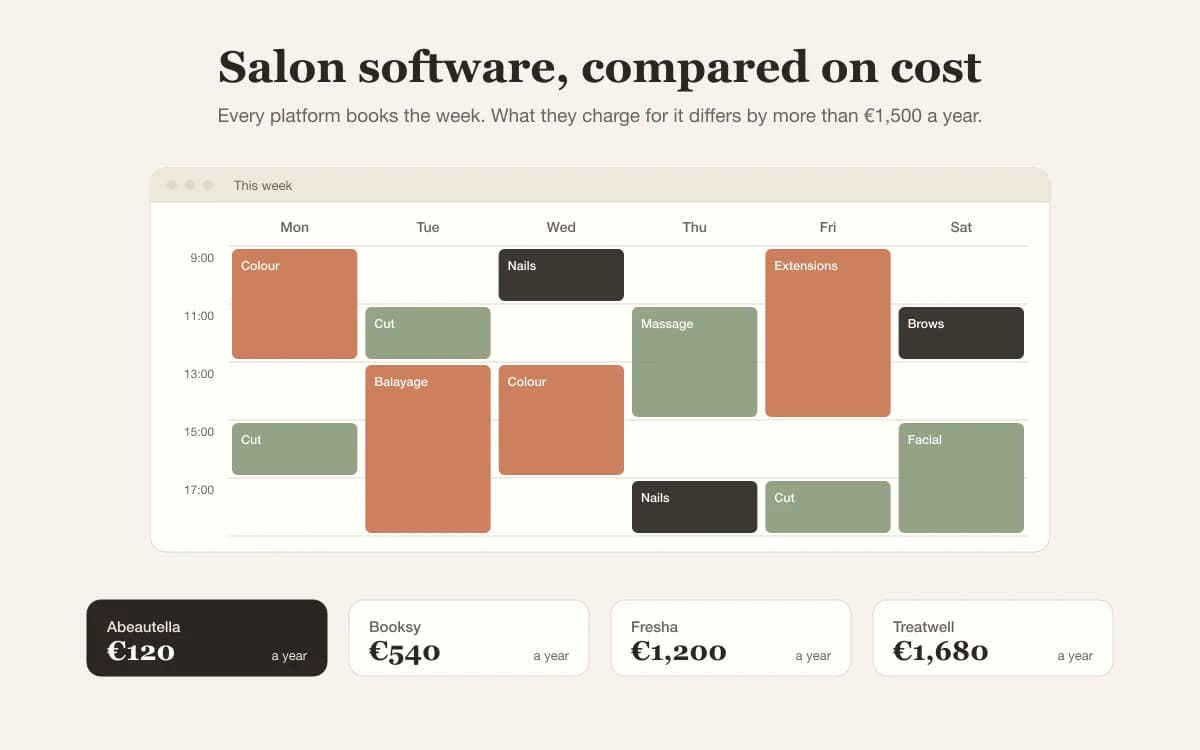
The last two are good products priced for a business with staff. Alone, you pay for a shape you do not have.
That is not a criticism of either. It is a mismatch, and mismatches are expensive in a way that missing features are not.
1. Abeautella
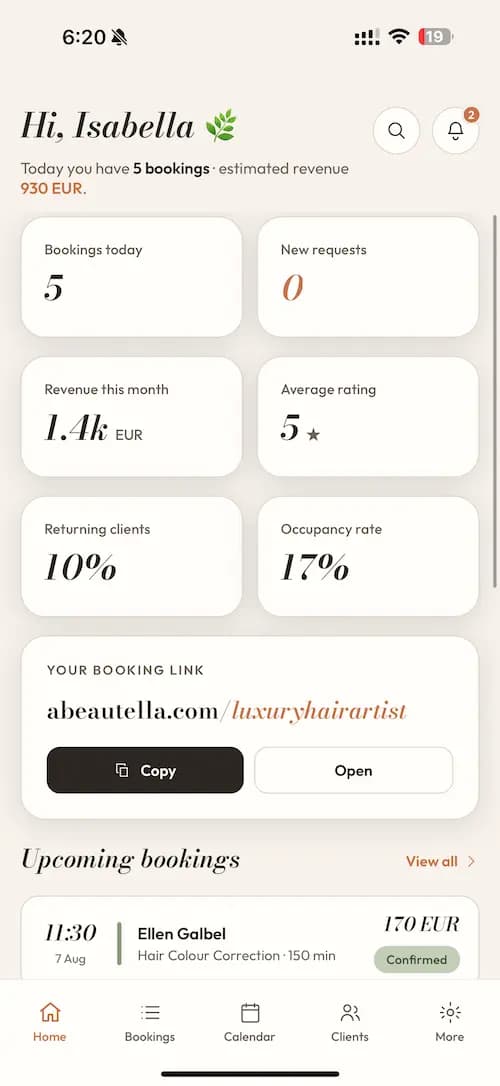
Placed first because the free plan is permanent and sized for one person: fifty bookings a month, which is most of a part-time book.
No commission on anything, so a client who finds you through your own link costs you nothing, now or in three years.
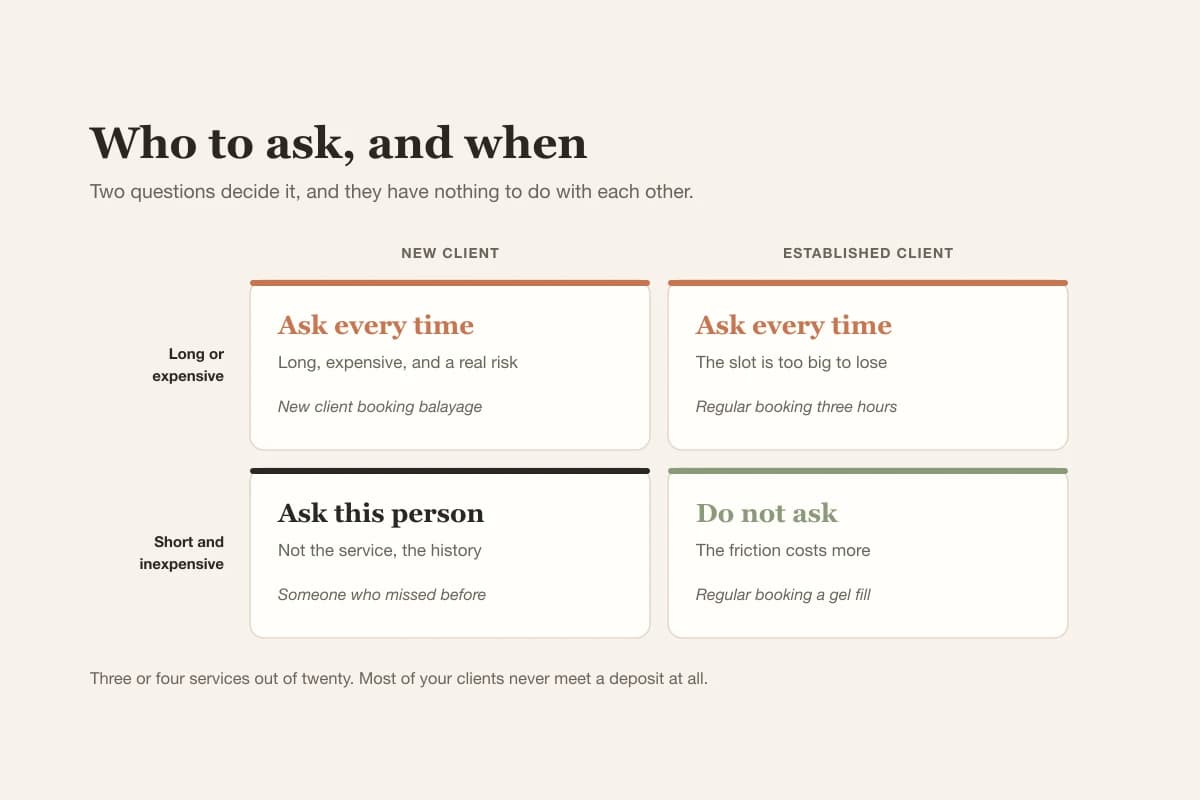
Deposits can be set on some services and not others, which working alone is the difference between a protected day and a lost one.
Past fifty bookings it is €10 a month, and the number does not change as you grow.
Where it loses: no marketplace. If nobody knows you exist yet, this does not solve that, and something else has to.
It is also newer than the rest of this list, which is worth weighing honestly.
Best for: a specialist with a book that is filling, who wants the relationship and the record to stay hers.
2. Square Appointments
The other permanently free option, and for one person it is a serious product rather than a stripped-down one.
Calendar, online booking, reminders and card payments, with no monthly fee and no countdown anywhere.
If you sell products alongside treatments, the till and stock side is better than anything else on this list.
Where it loses: it is a payments company that added booking, so anything specific to beauty is missing.
No processing time in the middle of a service, and no structured place for a contraindication or a product reaction.
The full picture is in where Square works and where it stops.
Best for: a specialist with simple services and retail, who does not need a treatment record.
3. Fresha
The one to consider if your problem is that nobody knows you exist, because the marketplace genuinely sends people.
For someone who has just gone independent, that machine is worth real money and cannot be built alone.
The subscription is modest and the product is polished. The cost is the fee on each new client it introduces.
Where it loses: the minimum fee. On treatments under about €30, you pay well above the advertised percentage.
That is the mechanism we set out in the nail salon comparison, and it applies to any short, modestly priced service.
Best for: the first year, or any period when you have hours you genuinely cannot fill.
4. Vagaro
A deep, capable product with a long history, and more than most independents will ever use.
Reporting, stock and rota tools are thorough, which matters if you are already running something closer to a small business.
Where it loses: the trial expires, the base price is aimed at teams, and setup takes a weekend.
Best for: an independent who rents space to one or two others and is halfway to running a salon.
5. Booksy
Strong on the client side, with an app people actually open to rebook, which is worth something on its own.
Commission is optional rather than automatic, applying only to Boost, which you control.
Where it loses: around €45 a month from your first client is a heavy commitment for one person.
That is €540 a year, which on €40 treatments is thirteen full appointments before you have earned anything.
Best for: an established independent with a full book, where the fee spreads across real volume.
What happens while your hands are busy
This is the part no feature list covers and the part that decides your week.
You are mid-treatment. The phone rings. You cannot answer, and the person calling books somewhere else.
With no reception, online booking is not a convenience. It is the only thing standing between an enquiry and a lost client.
Three things matter, and none of them is a headline feature.
- A link that works without an account. Every extra step loses people, and an account requirement loses the most.
- Automatic reminders, because you will not send them by hand at the end of a nine-hour day.
- Bookable hours you control, so a client cannot take the slot you keep for your own life.
The third is the one people set up last and regret first. Alone, nobody protects your evenings except you.
Block them in the software rather than in your head. A calendar that says yes at eight in the evening will keep saying yes.
The same applies to the gap between appointments. Alone, you also clean, restock, reply to messages and eat.
Build that into the service duration rather than hoping for it. A day booked end to end runs late from ten in the morning.
Five minutes added to each appointment costs you one slot a day and buys back the whole afternoon.
Nobody notices the padding. Everybody notices being kept waiting twenty minutes because the morning never recovered.
What a no-show costs when you work alone
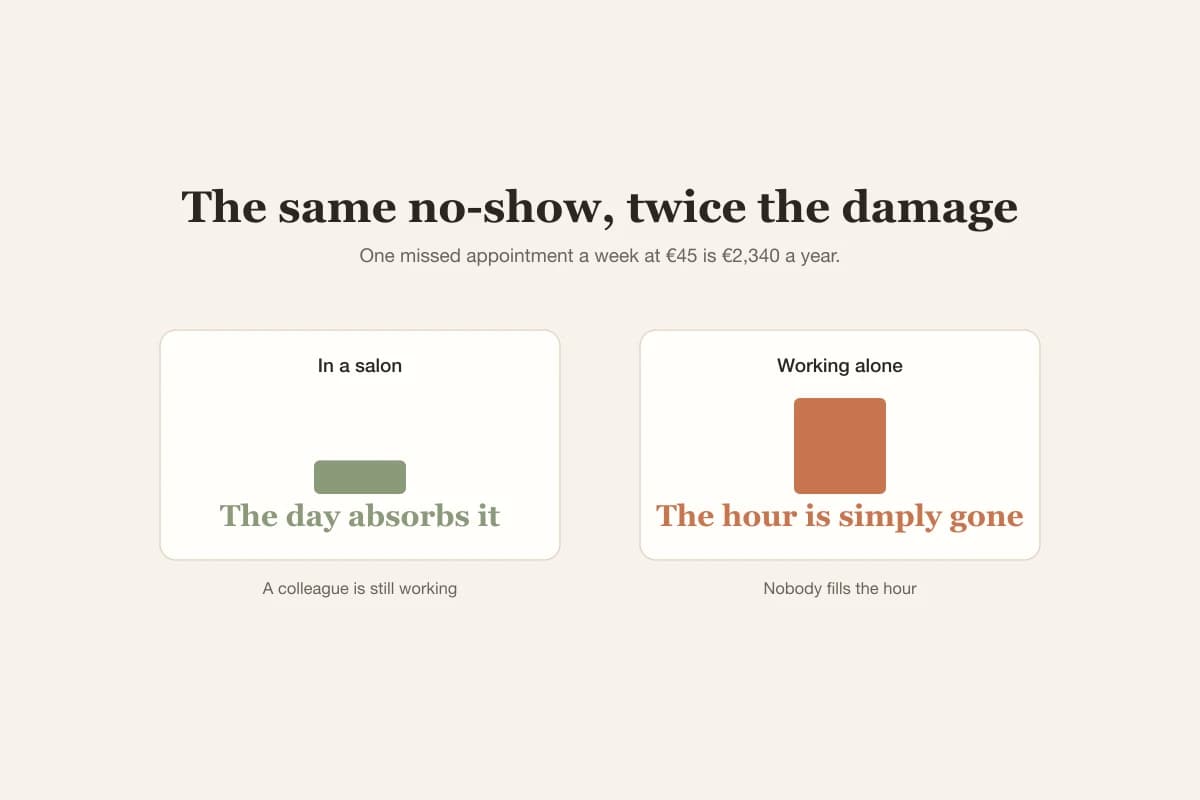
In a salon, a gap is absorbed. Someone else is working, the rent is covered, and the day still functions.
Alone, a no-show is the entire hour. There is no colleague filling it and no other income arriving that afternoon.
One a week at €45 is €2,340 a year, which is more than any software on this list costs, by a wide margin.
Which is why deposits matter more to an independent than to a salon, and why a blanket deposit is still the wrong answer.
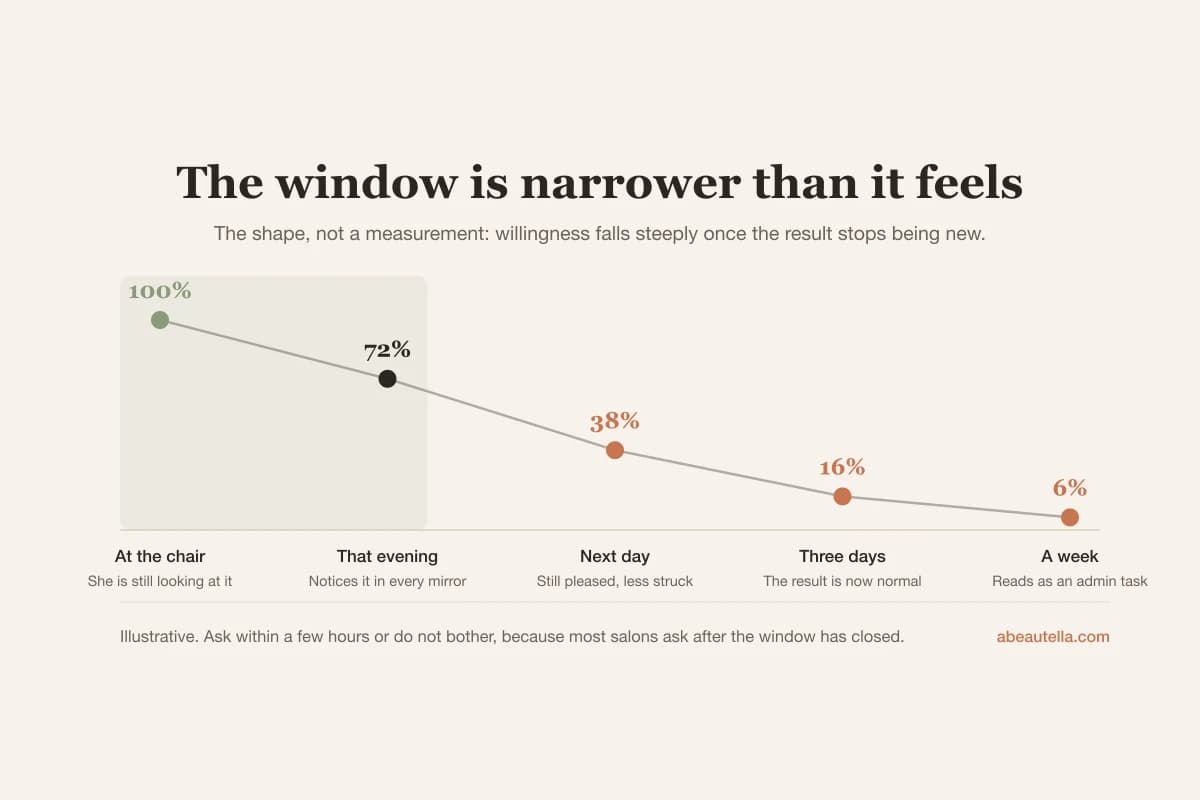
Ask for one on long treatments and on people who have missed before. The methods are in nine ways to reduce no-shows.
Where your clients actually come from
Working alone, you are the whole marketing department, and it is worth being honest about which channels do the work.
Almost every independent gets most of her book from two places, and neither of them is a marketplace.
Recommendation is the first and by a distance. Someone liked the result and told a friend, which costs nothing and converts better than anything you can buy.
Your own social profile is the second, because people want to see work before they book a face or a set of hands.
Both of those end at the same place: a link. If the link is missing or awkward, the interest evaporates between the profile and the booking.
So the single highest-value thing you can do is put a working booking link in your bio, your messages, and your replies.
A marketplace is a third channel and a legitimate one, but treat it as advertising with a price per client rather than as your shopfront.
Track where new people come from for one month. It takes a note on your phone and it settles arguments you would otherwise have with yourself for a year.
Choosing between them
| Your situation | Start with | Because |
|---|---|---|
| Just gone independent, few clients | Fresha | Discovery is the problem, and the fee is per client |
| Building a book, under 50 a month | Abeautella free | Permanent, and no card required |
| Full book, treatments over an hour | Abeautella | Deposits and a real treatment record |
| Simple services plus retail | Square | Free for one, and the till is genuinely good |
| Renting space to others | Vagaro | You are running a small salon now |
That last note is the real advice. The tool that suited your first month is rarely the one that suits your second year.
Put a reminder in the calendar for twelve months from the day you sign up, with one question on it: is this still the right one?
Ten minutes once a year is the whole discipline, and it is the difference between choosing a tool and drifting into one.
There is more for independent specialists on our own page, and the full field is in the best salon software.
The short version
Two of these five are free without an end date. If money is the constraint, start with one of those and take your time.
If nobody knows you exist yet, a marketplace is worth its fee, and it stops being worth it the month your week fills.
And whatever you choose, set your bookable hours before your first client, not after the first Sunday somebody books.