

Free is not a price. It is a position, and every platform in this category has taken one.
The software still costs money to build and run. If you are not paying a subscription, the money arrives from somewhere else.
Finding that somewhere else is the entire exercise, because it also tells you when the free part stops.
So this list is not ranked by how free each one sounds. It is ranked by what you give up in exchange.
The five things free can mean
Before any comparison is useful, it helps to separate arrangements that share a word and nothing else.
- Free up to a cap. Everything works, up to a number of bookings or one person. Past that you pay a stated amount.
- Free while you are alone. Complete for one person, and the price appears the day a second calendar exists.
- Free software, paid clients. No subscription at all, and a fee each time the platform introduces someone to you.
- Free for a while. Fourteen or thirty days, then a card. This is a trial, whatever the pricing page calls it.
- Free but not usable. A tier that exists to be listed, missing the one thing that makes the product work.
The first three are real offers with real trade-offs. The fourth is a sales process, and the fifth is a marketing line.
Nothing below is ranked above something else for being generous. It is ranked for being clear about which of the five it is.
Where the money actually comes from
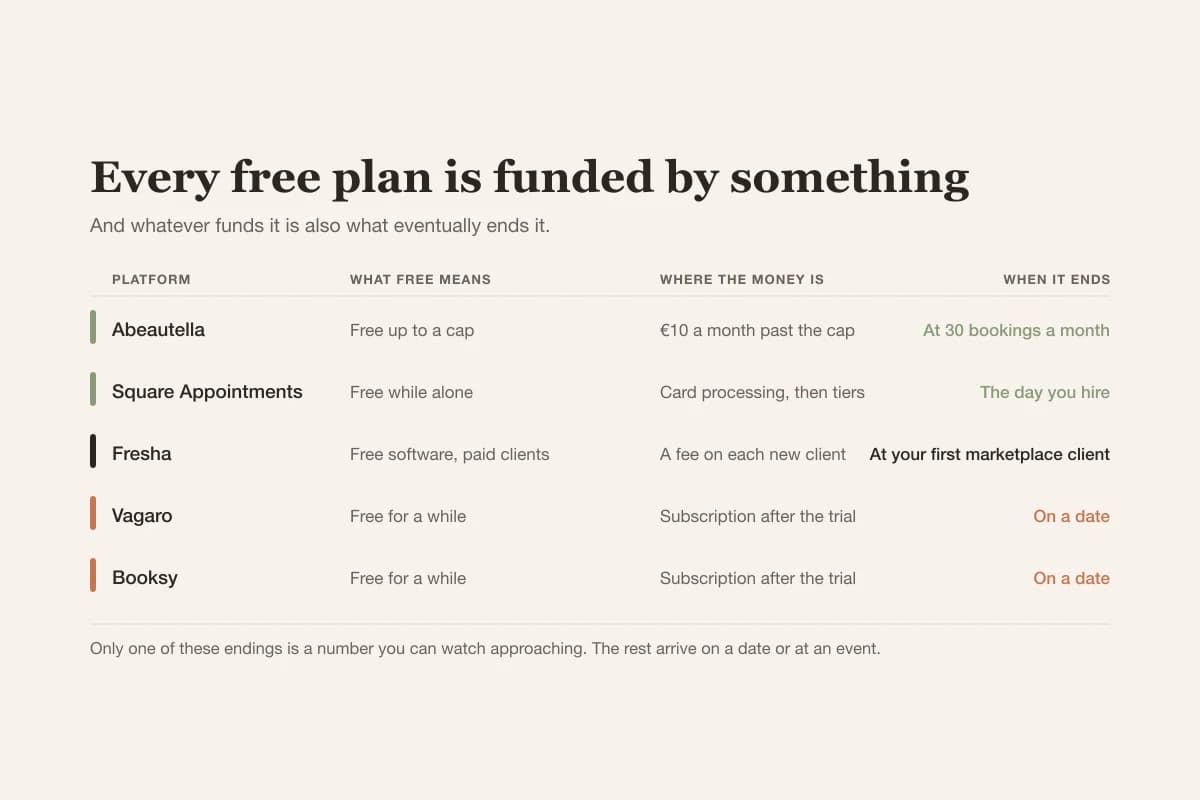
| Platform | What free means | Where the money comes from | When it ends |
|---|---|---|---|
| Abeautella | Free up to a cap | €10 a month past the cap | At 30 bookings a month |
| Square Appointments | Free while alone | Card processing, then paid tiers | The day you hire |
| Fresha | Free software, paid clients | A fee on each new client | At your first marketplace client |
| Vagaro | Free for a while | Subscription after the trial | On a date |
| Booksy | Free for a while | Subscription after the trial | On a date |
Read the last column rather than the first. It is the only one that tells you what happens in month three.
Two of these endings arrive because your salon did well. One arrives on a date that has nothing to do with you.
1. Abeautella
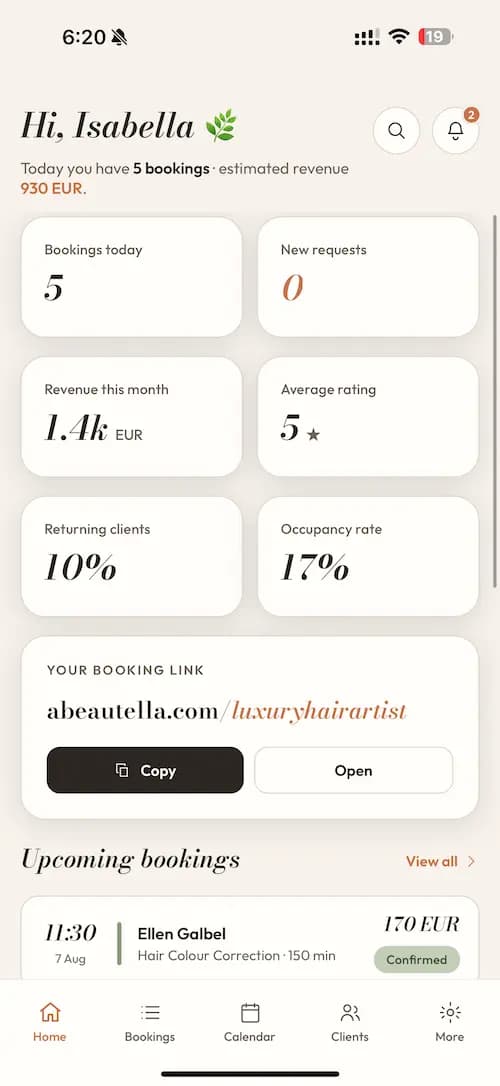
First because the free plan ends at a number you can see coming, rather than on a date or at an event.
Thirty bookings a month for one person, permanently, with online booking, reminders, deposits and a client record included.
Nothing is held back to make the paid plan look better. Past thirty bookings it is €10 a month and nothing else changes.
No commission at any volume, so a busy month costs the same as a quiet one.
Where it loses: thirty bookings is a book that is still filling up. A specialist working most days passes it and starts paying.
There is also no marketplace, so it will not bring you anybody. Discovery has to come from somewhere else.
Best for: a specialist starting out, or anyone who wants a year to decide without a deadline attached.
2. Square Appointments
The most generous free plan here by volume: one person, unlimited bookings, no monthly fee and no countdown.
A full-time solo specialist can run an entire year on it without paying a subscription at all.
Card processing funds it, at around two per cent, which you would pay on any platform with any processor.
Where it loses: the cliff is headcount rather than volume, and it arrives without warning the day you hire.
It is also a payments company that added booking, so nothing specific to beauty is present.
The whole picture is in where Square works and where it stops.
Best for: a busy solo specialist with simple services who does not plan to hire this year.
3. Fresha
The most interesting position on this list, and the one most often misunderstood in both directions.
The software genuinely costs nothing on the basic tier. The revenue comes from the marketplace instead, per new client.
For a salon with empty hours that is a good bargain: you pay only when the platform produces something you did not have.
Where it loses: the fee has a minimum of around €6, so cheap services pay far more than the advertised percentage.
Fresha documents that floor in its own help centre, and it is why a €20 service pays thirty per cent rather than twenty.
The arithmetic is worked through in what a year of commission costs.
Best for: a salon that needs clients more than it needs to protect margin, for as long as that is true.
4. Vagaro
A capable, mature product with a trial rather than a free plan, which is a different offer honestly presented.
The trial is genuinely the full product, so it answers the question a limited free tier cannot: does this fit my week?
Where it loses: it ends on a date, which means the decision gets made under time pressure rather than on evidence.
Best for: a salon that already knows it will pay for software and wants to test the full thing before choosing.
5. Booksy
Also a trial rather than a free plan, and priced from around €45 a month once it ends.
What it does well is worth noting: commission is optional here, applying only to Boost, which you switch on yourself.
Where it loses: the highest starting price on this list, committed from your first client rather than your thirtieth.
Best for: an established salon with volume, where the subscription spreads thinly and the app is genuinely used.
What gets held back on a free tier
A free plan is honest when the limit is a quantity and less honest when the limit is a capability.
Capping bookings is fair: you use the whole product, and you pay when the product is clearly earning.
Removing reminders is not, because reminders are most of the value and their absence costs you more than the subscription.
Four things are worth checking specifically, because these are where free tiers are usually cut.
- Automatic reminders. If they are missing or capped, the free plan is costing you no-shows to save you a fee.
- Your own booking link. Some free tiers only publish you inside a marketplace, which is a different product entirely.
- Client export. A free plan you cannot leave is not free, it is deferred.
- Deposits. Often paid-only, and often the single most useful thing against a missed appointment.
Test all four in the first hour. Each takes minutes now and months to discover the hard way.
The reminders one is worth dwelling on, because it is the most common cut and the most expensive.
A salon losing two appointments a month to forgetfulness is losing more than any subscription on this list costs.
A free plan that saves you €10 and costs you €120 in missed bookings is not a saving, it is a trade you did not know you made.
Why anyone gives software away
It is worth understanding the business logic, because it predicts how a free plan will behave over three years.
Software has a high cost to build and almost none to serve one more salon. That shape rewards giving it away.
A free plan is cheap to run and expensive to leave, since your clients, your history and your habits all end up inside it.
That is not sinister. It is the same reason a salon offers a first-visit price: get someone in, then be good enough to keep them.
The difference between a fair free plan and an unfair one is whether leaving is possible.
A platform confident in its product lets you export everything. A platform relying on the difficulty of leaving does not.
So test the export on day one, while you have nothing to lose, rather than in year two when you have everything to lose.
Download the file, open it, and see whether your client history is actually in there. That single test tells you more than any pricing page.
How long free actually lasts
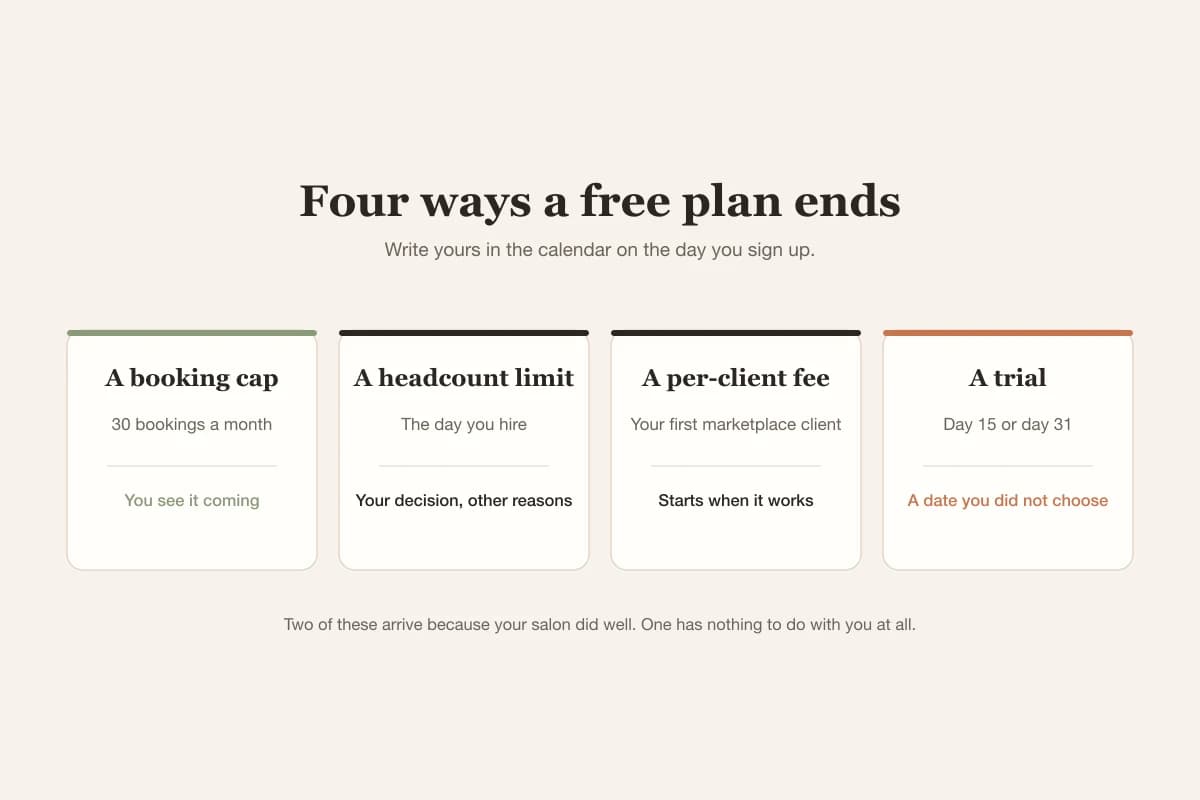
A trial ends on a date you did not choose. A headcount limit ends on a day you did choose, but for other reasons.
A per-client fee starts the first time the marketplace works, which is to say the first time it does its job.
A booking cap is the only trigger you can see approaching, week by week, and plan around calmly.
That is the argument for ranking it first. Not generosity, predictability.
A decision made calmly in month eight is almost always better than the same decision made on the last day of a trial.
By then you know what you actually use, what you never opened, and which limitation genuinely gets in your way.
None of that is knowable in fourteen days, which is why trials produce so many decisions people later reverse.
Choosing between them
| Your situation | Start with | Because |
|---|---|---|
| Part-time, building a book | Abeautella free | Thirty a month with nothing held back |
| Full-time solo, simple services | Square | Unlimited bookings for one person |
| Empty hours, need clients | Fresha | You pay only when it produces someone |
| Ready to pay, want to test first | Vagaro | The trial is the full product |
| Established, high volume | Booksy | The subscription spreads across real work |
Whichever you pick, write the ending in your calendar on the day you sign up. A date, a headcount, or a number of bookings.
The full field, free and paid together, is in the best salon software.
The short version
There are only two permanently free plans here, and both are genuinely usable rather than demonstrations.
Square gives you more volume; Abeautella gives you the beauty-specific half and a limit you can see coming.
Fresha is free in a third sense, and whether that is cheap depends entirely on your prices and how full you are.
The other two are trials, honestly run, and worth using as trials rather than mistaken for free plans.
Whichever you start with, do the export test in the first week and write the ending date or number in your calendar.
Those two habits cost you twenty minutes and remove almost every unpleasant surprise this category is known for.
The wider comparison, including the platforms that never pretend to be free, is in the best salon software.