Ask anyone how salon software is priced and you get two answers. A monthly fee, or a cut of what you earn.
They are described as a choice, and the whole industry writes about them that way. Pick the model that suits your volume.
On several platforms it is not a choice. The subscription is charged, and then the commission is charged on top of it.
That structure is not hidden, but it is never presented as one number, which is why so few salons notice they are inside it.
The two models, as they are usually described
It is worth stating both plainly before showing what happens when they overlap.
A subscription is a fixed monthly amount. It does not care how much you earn, which makes it expensive when you are quiet and cheap when you are busy.
A commission is a percentage of bookings. It costs nothing when you are quiet, and it grows without limit exactly as your salon succeeds.
Each has a defensible logic. A new salon usually prefers the second, an established one almost always prefers the first.
The problem starts when a platform applies both, because the two logics stop cancelling out and start compounding.
What the overlap looks like on one booking
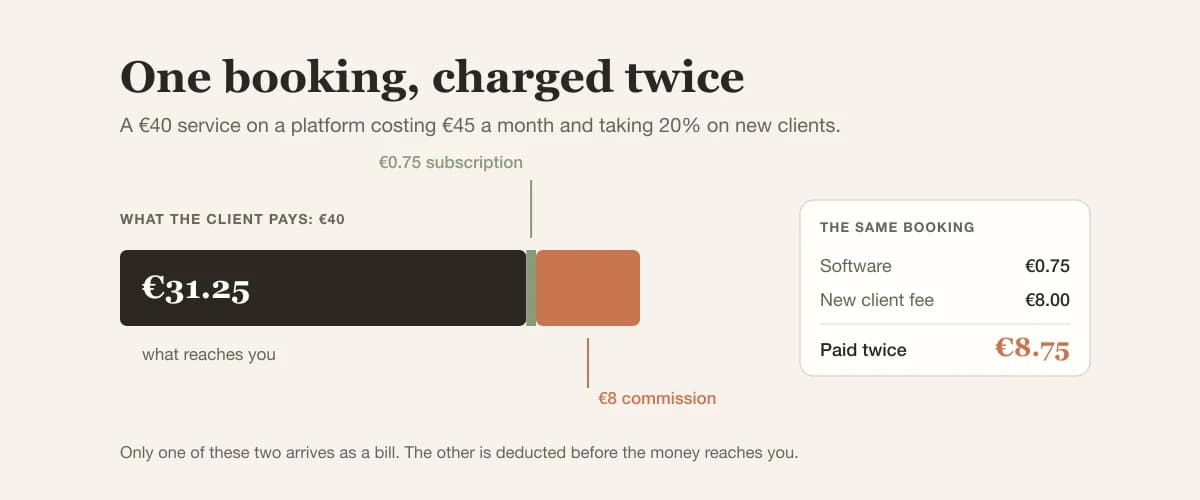
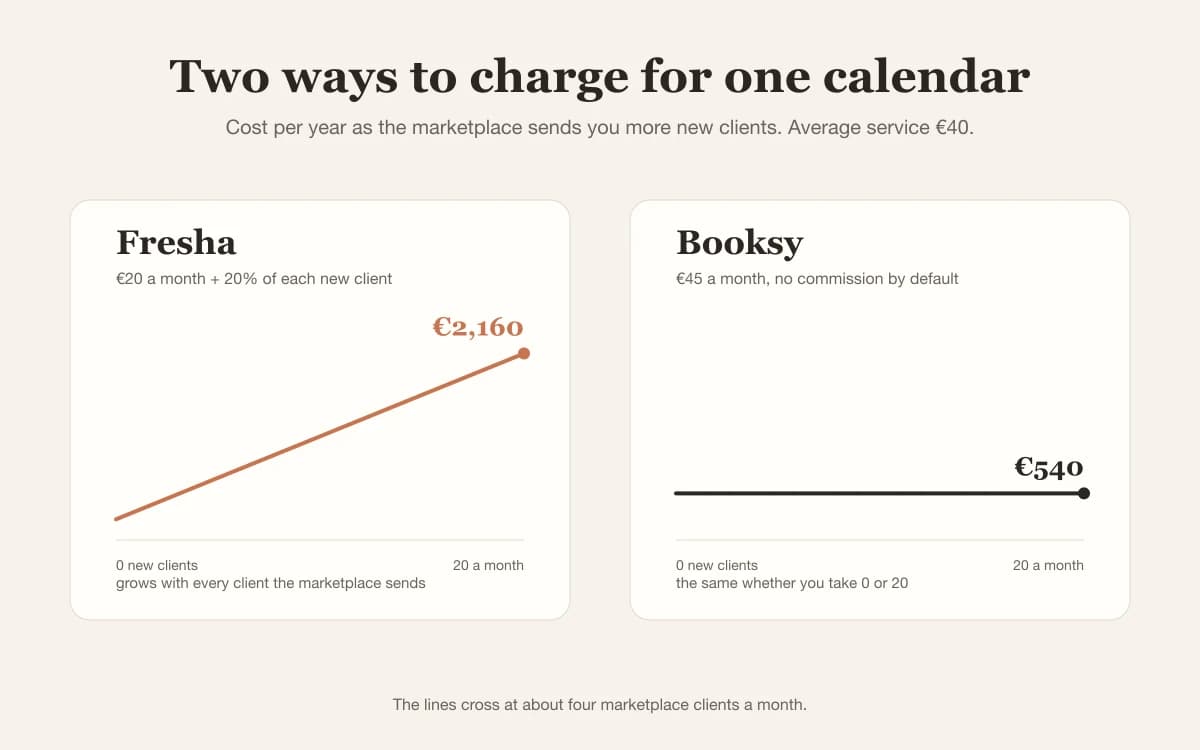
Take a salon doing 60 bookings a month at €40, on a platform charging €45 a month and 20% on clients it introduces.
Every booking already carries €0.75 of subscription, whether or not anything else applies to it.
A booking from a new client the platform sent you carries that same €0.75, plus €8 in commission.
You paid for the software, and then you paid again for the client who used it. Both charges are real, and only one of them is on the invoice.
The arithmetic over a year
| Structure | Subscription | Commission | Year |
|---|---|---|---|
| Subscription only, no commission | €120 | €0 | €120 |
| Commission only, no subscription | €0 | €960 | €960 |
| Both, as several platforms charge | €540 | €960 | €1,500 |
The third row is not a worst case. It is the standard arrangement on a mid-priced platform with an active marketplace.
€1,500 against €120 is not a difference in features. It is twelve and a half times the price for the same working week.
Nothing in that gap is explained by software quality. The expensive row buys you a marketplace listing, and nothing else.
Whether that listing is worth €1,380 a year is a question with a real answer, and it is different for every salon.
We ran a single platform's version of this in detail in what a year of Fresha commission costs.
How to tell whether you are paying both
This takes twenty minutes and it is the only way to know, because no dashboard shows you the total.
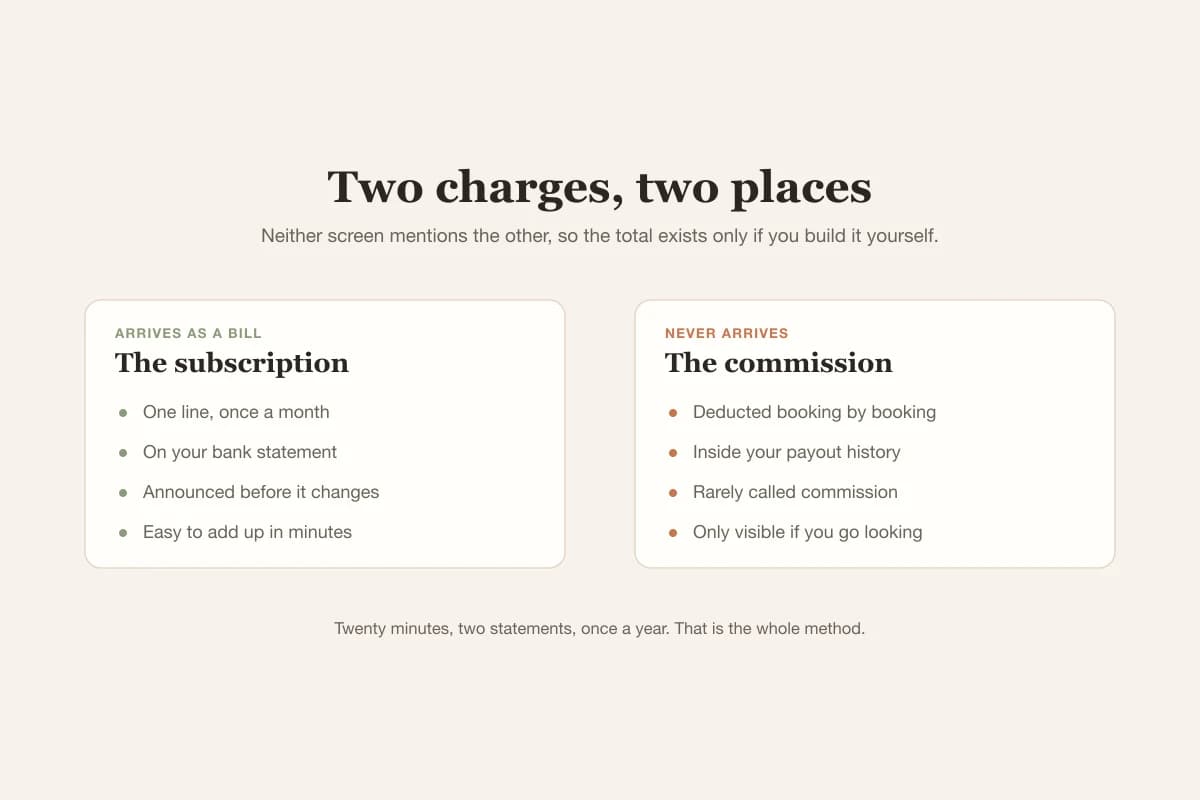
The two halves live in different systems, and neither one has any reason to mention the other.
- Find last year's subscription charges on your card or bank statement. Add them up. This is the easy half.
- Open your payout history on the platform and find the deduction column. It is rarely called commission.
- Add twelve months of deductions. Look for words like service fee, new client fee, marketplace fee, or boost.
- Add the two totals together. That is what the platform cost you, and it is almost certainly not the number in your head.
- Divide by your bookings. Now you know what each appointment pays for software, which is the only comparable figure.
Most salons that do this find the second number is larger than the first, sometimes several times larger.
That is the whole point of the structure. The charge that grows with your success is the one you never see as a bill.
The names commission travels under
Very few platforms use the word. Recognising the alternatives is most of the work.
- New client fee, charged the first time someone books through the marketplace.
- Service fee or platform fee, deducted from the payout rather than billed to you.
- Boost, promote, or featured, which is commission you switched on yourself and may have forgotten about.
- Processing, which is legitimate card cost and should be separated from the rest before you judge anything.
- Lead fee, charged per enquiry rather than per booking, which can cost more than a percentage would.
Only the fourth of those is a genuine third-party cost. Everything else is the platform's revenue under a friendlier name.
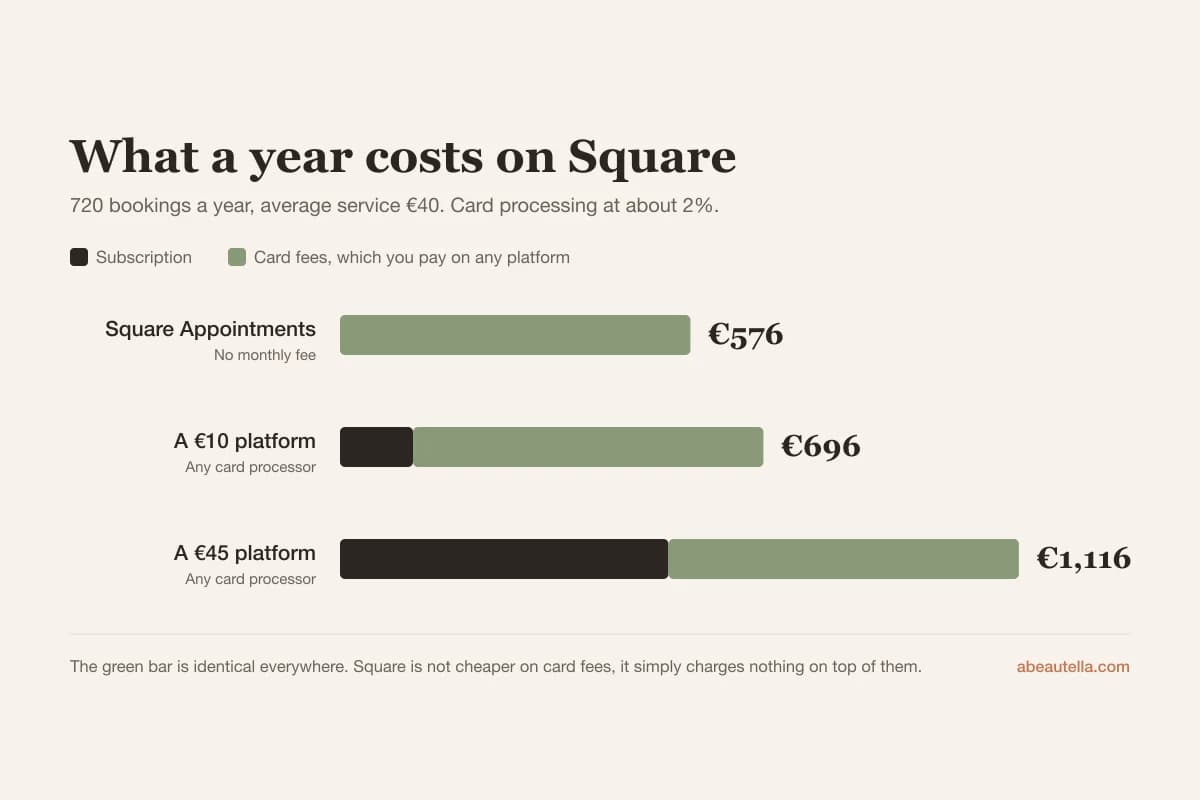
Card processing deserves that exemption. Someone genuinely moves the money and genuinely charges for it, on every platform in existence.
Strip it out before you compare anything, or you will credit one platform for a cost that all of them share.
Everything left after that subtraction is a business decision, and business decisions can be renegotiated or walked away from.
Why platforms are built this way
It is not a trick, and understanding the logic makes it easier to judge whether it applies to you.
A booking platform runs two businesses that cost very different amounts to operate.
The software half is cheap once built. Servers and support scale slowly, so a flat monthly fee covers it comfortably.
The marketplace half is expensive forever. Every new client arrives through advertising that has to be bought again next month.
A percentage is the only sane way to fund that, because it costs the platform nothing when nobody books.
So two charges for two genuinely different services is defensible in principle. The question is whether you use both services.
A salon that has been full for three years is paying into an advertising machine it stopped needing in year one.
Nothing about that is dishonest on the platform's side. It is simply a bill nobody sends you a reminder to reconsider.
The two halves move independently
This is the part that makes the structure hard to keep track of over several years.
A subscription increase arrives as an email with a date on it. You notice it, you weigh it, and you decide.
A commission change arrives as a paragraph in updated terms, and it applies to money you never saw in the first place.
The rate can move, the definition of a new client can move, and the list of what counts as a chargeable booking can move.
Treatwell's twelve-month reset is the clearest example: a returning client becomes new again, and is charged again, as we covered in the 35% question.
None of this is hidden. All of it is easy to miss, because the charge never arrives as a bill you have to approve.
That asymmetry is the real cost of the double structure, and it is why the yearly calculation is worth putting in the diary.
When paying both is still defensible
There is a case, and skipping it would make this article dishonest.
If the marketplace genuinely fills chairs that would otherwise be empty, the commission is advertising and the subscription is software.
Two costs for two different things is not a scandal. Paying for advertising you no longer need is.
The test is the one from marketplace or your own link: divide the yearly commission by the number of genuinely new people it brought.
If that comes to €15 a client, the arrangement is working and you should probably lean into it harder.
If it comes to €150, the marketplace is charging you for clients you already had, and the subscription is the only part earning its keep.
Note that the answer changes on its own, without anybody deciding anything. As your own book fills, the marketplace sends a smaller share of your work.
The commission does not shrink to match. It follows your turnover, which is going up, not the platform's contribution, which is going down.
That divergence is slow enough to be invisible month to month and obvious across three years.
What a single-charge platform looks like
The alternative is not complicated, and it is worth knowing what to look for.
| Question to ask | A single-charge platform | A double-charge platform |
|---|---|---|
| What does a booking cost? | Nothing. The fee is monthly | Depends who the client is |
| Is anything deducted from payouts? | Card processing only | Processing, plus a platform share |
| Does the bill grow as I grow? | No, until you change plan | Yes, without a ceiling |
| Can I see the yearly total today? | Yes, it is twelve identical charges | Only by adding two sources |
A price you can say out loud is worth something on its own, separately from whether it is low.
It lets you plan, it lets you compare, and it means a good month does not quietly cost you more than a bad one.
What to do this week
Whatever you decide afterwards, the twenty-minute calculation is worth doing before you renew anything.
If you are on a marketplace and it is filling empty hours, keep it and price it as advertising, per new client.
If you are paying a subscription and a percentage on clients who have been coming for years, one of those two charges is buying you nothing.
For a barbershop or a nail studio running high volumes at modest prices, the percentage is the one that hurts.
Sixty small bookings a month is where a commission does the most damage, because the fee is proportional and the margin is not.
And if you are about to sign up somewhere new, ask one question before anything else: what does a booking cost me?
A platform that charges only a subscription can answer in three words. One that cannot answer simply is telling you something.
The short version
Subscription and commission are presented as a choice. On several platforms they are two charges on the same appointment.
You will not find the total on any screen, because the two halves live in different places and are named differently.
Add them yourself once a year. Twenty minutes, two statements, and you will know what your software actually costs.
Then decide whether both halves are still earning it. That is the only version of this decision that is made on evidence.