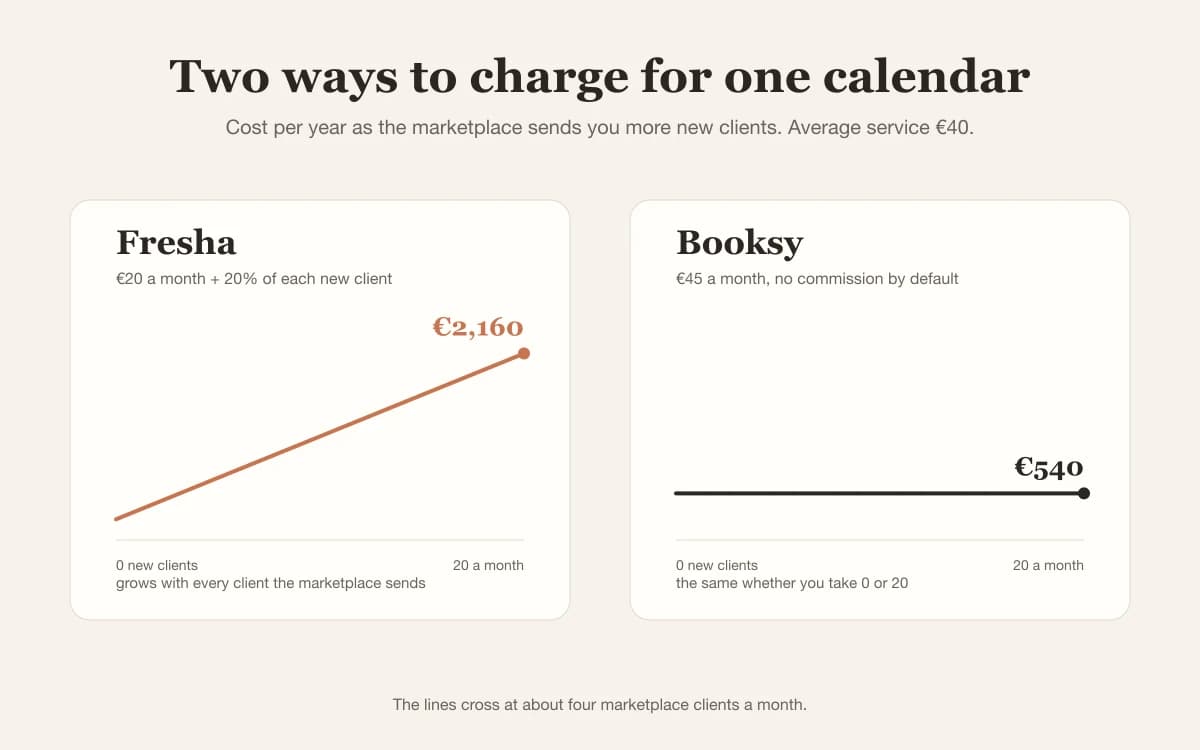
Fresha and Booksy are the two names a salon hears first. Both give you online booking, a calendar, reminders and a client list.
On features they are close enough that a feature table will not decide anything for you. Where they differ completely is how they take your money.
One is almost free until it introduces you to a client. The other charges a real subscription from the first day and then stays out of your margin.
Which is cheaper is not a fixed answer. It depends on one thing about your salon, and this guide is about finding out which side of it you are on.
The short version
| Fresha | Booksy | |
|---|---|---|
| Monthly cost | Around €20 | From around €45, plus about €5 per extra team member |
| Commission on a new client | 20% of the first booking, minimum around €6 | None by default. 30% only if you switch on Boost |
| Commission on returning clients | None | None |
| Marketplace | Yes, large, and it is the point | Yes, and it is optional |
| Free plan | The software is free, the marketplace is not | Trial only |
| Costs least when | You take few new clients from the marketplace | You take many new clients and have the volume to absorb the fee |
Read the second row twice. It is the whole difference between them, and it is worth more than every other row combined.
Two ways to sell the same calendar
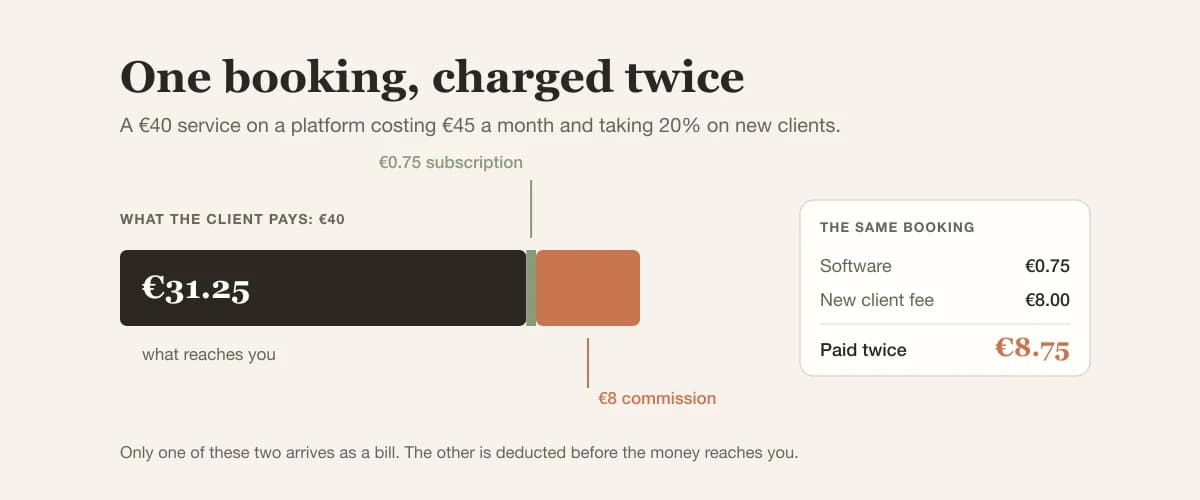
Fresha keeps the subscription low and earns when its marketplace sends you someone new. You pay for the client, not for the software.
Booksy does the opposite. It charges a real monthly fee and then does not touch your bookings, unless you choose to pay for promotion.
Neither model is dishonest. They answer different questions: do you need software, or do you need clients?
What a year costs, at four volumes
Numbers make this concrete. Take an average service of €40, and count only the clients the marketplace introduces, not the ones you bring.
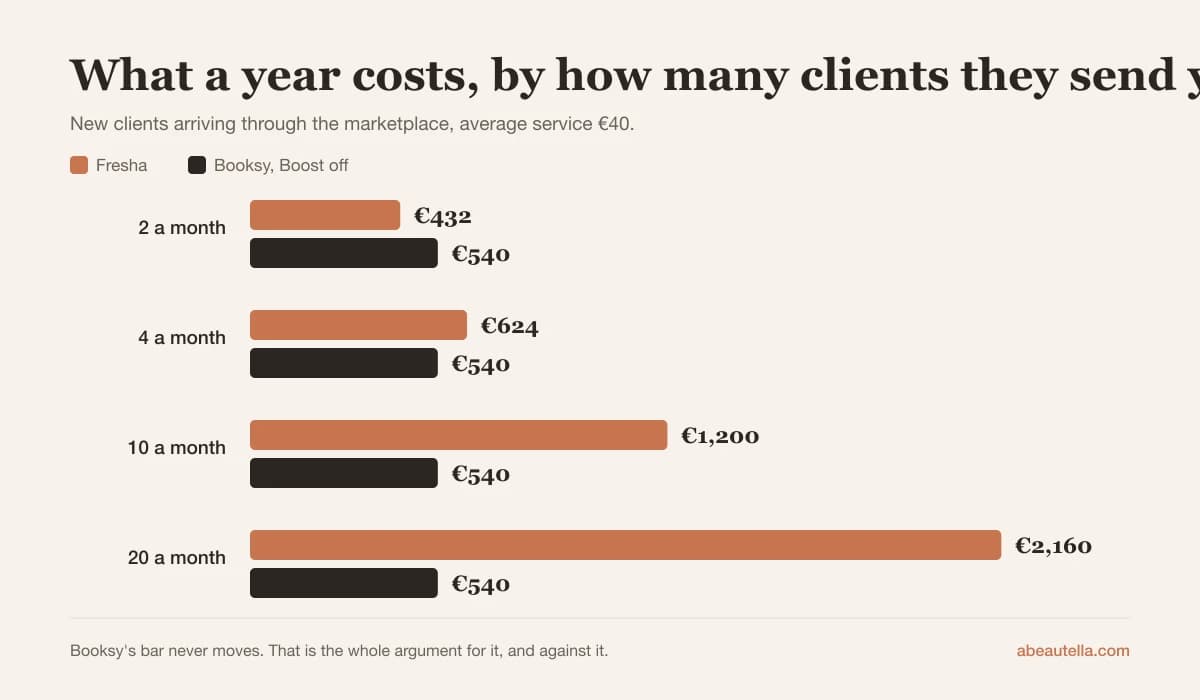
| New clients from the marketplace | Fresha a year | Booksy a year | Cheaper |
|---|---|---|---|
| 2 a month | €432 | €540 | Fresha |
| 4 a month | €624 | €540 | Roughly level |
| 10 a month | €1,200 | €540 | Booksy |
| 20 a month | €2,160 | €540 | Booksy, by a wide margin |
The crossover is around four new marketplace clients a month. Below it Fresha wins, above it Booksy wins, and the gap widens fast.
That is a strange result at first glance. The platform with the higher price tag becomes the cheap one, precisely because its price stops growing.
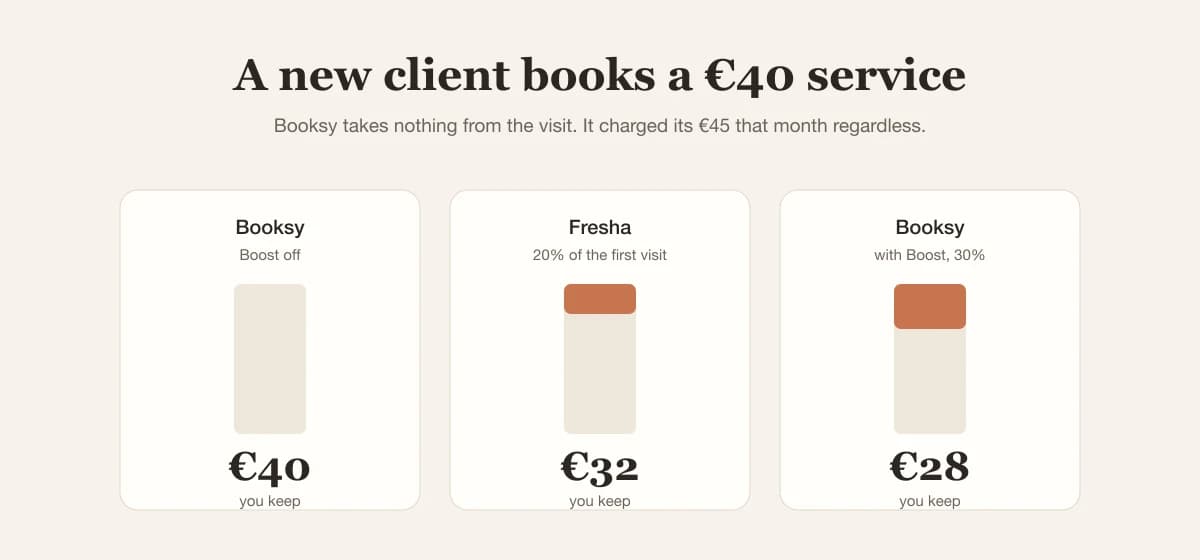
Fresha takes €8 from a €40 first visit. Booksy takes nothing, having already charged €45 that month whether anyone booked or not.
Neither number is the real cost. The real cost is the yearly total from the table above, and that depends entirely on your volume.
Who owns the client afterwards
Both platforms stop charging once a client is yours. The disagreement is about when that happens, and it is worth understanding.
A client who found you on a marketplace has an account there. Their rebooking habit lives inside an app you do not control.
That is fine while you stay. It becomes expensive the day you leave, because the habit does not move with you.
A client who booked through your own link, from your Instagram bio, has no such account. They come back to you, not to a platform.
Which one fits which salon
Fresha is the better answer when
- You are opening with no following. The marketplace is real demand, and the commission is an advertising budget with an end date.
- You are in a busy district where people search for a salon nearby rather than by name.
- Your quiet months are very quiet. A low subscription costs you little when nobody books.
- You want payments handled in the same place as the calendar, without adding a second provider.
In all four cases the commission buys something you do not otherwise have. That is a purchase, not a leak.
Booksy is the better answer when
- You are full and your clients rebook. A fixed fee gets cheaper per booking every month you grow.
- You have staff. The per-member cost is predictable, where a commission on every new client is not.
- You dislike surprises more than you dislike a standing cost.
- You want promotion to be a decision, switched on for a slow month and off again.
Booksy's structure is the more honest of the two on this point. You choose when to pay for reach, instead of paying by default.
Neither of them fits when
There is a third case that neither is built for, and it is common: a solo specialist with a following and no need for strangers.
For that person, €45 a month is a lot for a calendar, and 20% of a new client is a lot for someone who found them on Instagram anyway.
We built Abeautella for exactly that gap: a permanent free plan for one person, then €10 a month, and no commission at any tier.
We have no marketplace, which is the trade, and it is the first thing to weigh rather than the last.
Take that as the interested opinion it is. The point stands without us: if nobody needs to introduce you to your clients, do not pay an introduction fee.
What your client sees when they book
The two platforms put your salon in front of people in different ways, and that shapes who ends up in your chair.
On a marketplace, your salon appears next to every other salon nearby. The client compares you on price, distance and star rating, side by side.
That works if you are cheaper or closer. It works against you if your prices are higher because your work takes longer.
Your own booking link does the opposite. The client arrives already convinced, from your profile or a recommendation, and sees only you.
Both platforms give you a link. The difference is whether that link is the main road, or the side entrance to a shopping centre.
Neither is wrong. But a salon that competes on craft rather than on price is usually better served by the first.
Deposits, reminders and empty chairs
Both send automatic reminders, and both let you ask for a deposit or hold a card. This is where a marketplace earns some of its fee.
A client with an account, a saved card and a review history behaves better than an anonymous booking. The platform carries some of that trust for you.
It is a real benefit, and it is rarely counted. A no-show on a €60 service costs more than the commission on two new clients.
The catch is that the trust belongs to the platform, not to you. Take the same client to your own system and you start again from zero.
That is manageable. Ask for a deposit only on the long services, send a reminder the day before, and the difference mostly disappears.
What leaving costs
Nobody chooses booking software expecting to change it, and almost everybody does within three years. It is worth asking the question early.
Contact details are the easy part. Both platforms let you export a client list, and you should confirm that yourself before you commit.
The hard part is the habit. A client who has booked you through the same app fourteen times will open that app the fifteenth.
Moving them means telling every one of them, personally, that you book somewhere else now. Some will not make the trip.
This is the strongest argument for bringing your own clients through your own link from the start, whichever platform runs the calendar behind it.
The things that are not on the price list
Minimum fees bite hardest on cheap services
A 20% cut of a €60 colour is €12. On a €25 manicure the minimum fee applies instead, so you pay around €6, closer to a quarter.
If your average ticket is low, a percentage plus a floor is worse than the percentage suggests. Check the floor, not the headline rate.
A returning client can become new again
Many marketplaces reset a client to new after twelve months without a visit. For seasonal work, you can pay acquisition twice for the same person.
Card fees sit on top of everything
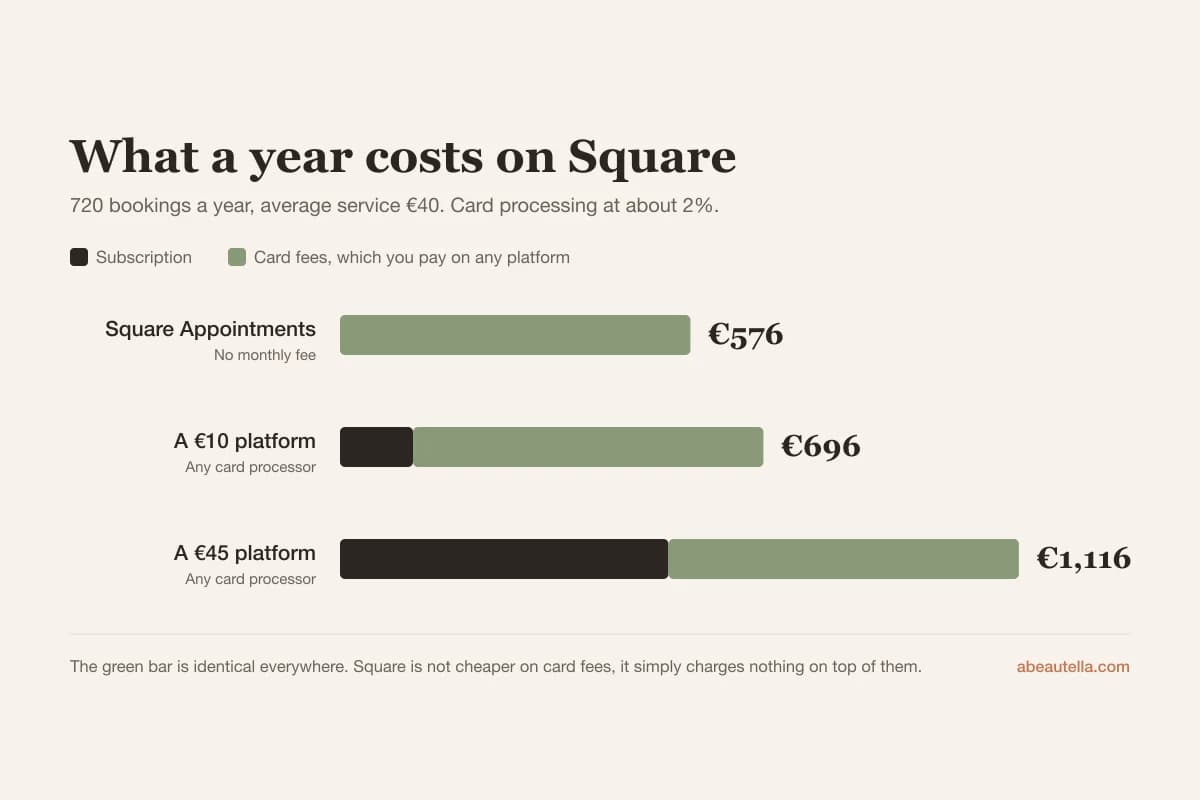
Both platforms process card payments, and both take a percentage of the transaction on top of any subscription or commission.
It is a small number and it applies to every paid booking, not only to new clients. Over a year on a full book it is not small.
Check it before you compare anything else. A platform can be cheaper on subscription and dearer once the card fee is counted.
Per-member pricing changes the answer
Booksy's base is one figure; each extra chair adds to it. A three-person salon is not paying the price on the homepage.
How to decide in ten minutes
- Count last month's new clients and how many found you rather than were sent to you.
- Multiply the sent ones by 20% of your average service. That is the Fresha side.
- Compare it with €45 a month, plus about €5 for each extra person. That is the Booksy side.
- Ask whether you want the marketplace at all. If the answer is no, neither price is the right price.
- Check the export function on the one you pick, before you enter a single client.
Verdict
Below roughly four marketplace clients a month, Fresha costs less. Above it, Booksy costs less and the gap keeps widening.
But the more useful question is not which of the two. It is whether you need a marketplace at all, and only you can answer that.
If you do need one, both are reasonable, and the arithmetic above tells you which.
If you do not, you are choosing between two prices for something you were never going to use.
Whichever you pick, put your own booking link in your bio on the first day. It costs nothing and it changes what leaving looks like later.